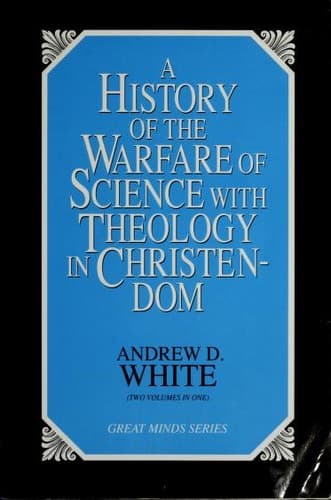
History of the Warfare of Science with Theology in ChristendomWhite, Andrew Dickson
Religion
History of the Warfare of Science with Theology in Christendom
White, Andrew Dickson
Religion and science -- History
In the middle of the thirteenth century we have a triumph of this
theological method in the great work of the English Franciscan
Bartholomew on The Properties of Things. The theological method as
applied to science consists largely in accepting tradition and in
spinning arguments to fit it. In this field Bartholomew was a master.
Having begun with the intent mainly to explain the allusions in
Scripture to natural objects, he soon rises logically into a survey of
all Nature. Discussing the "cockatrice" of Scripture, he tells us: "He
drieth and burneth leaves with his touch, and he is of so great venom
and perilous that he slayeth and wasteth him that nigheth him without
tarrying; and yet the weasel overcometh him, for the biting of the
weasel is death to the cockatrice. Nevertheless the biting of the
cockatrice is death to the weasel if the weasel eat not rue before. And
though the cockatrice be venomous without remedy while he is alive,
yet he looseth all the malice when he is burnt to ashes. His ashes be
accounted profitable in working of alchemy, and namely in turning and
changing of metals."
Bartholomew also enlightens us on the animals of Egypt, and says, "If
the crocodile findeth a man by the water's brim he slayeth him, and then
he weepeth over him and swalloweth him."
Naturally this good Franciscan naturalist devotes much thought to the
"dragons" mentioned in Scripture. He says: "The dragon is most greatest
of all serpents, and oft he is drawn out of his den and riseth up into
the air, and the air is moved by him, and also the sea swelleth against
his venom, and he hath a crest, and reareth his tongue, and hath teeth
like a saw, and hath strength, and not only in teeth but in tail, and
grieveth with biting and with stinging. Whom he findeth he slayeth.
Oft four or five of them fasten their tails together and rear up their
heads, and sail over the sea to get good meat. Between elephants and
dragons is everlasting fighting; for the dragon with his tail spanneth
the elephant, and the elephant with his nose throweth down the
dragon.... The cause why the dragon desireth his blood is the coldness
thereof, by the which the dragon desireth to cool himself. Jerome saith
that the dragon is a full thirsty beast, insomuch that he openeth his
mouth against the wind to quench the burning of his thirst in that wise.
Therefore, when he seeth ships in great wind he flieth against the sail
to take the cold wind, and overthroweth the ship."
Public-domain text, read in full here on John Shaqi.
Reviews
Reviews
No reviews yet
Be the first to share your thoughts on this work.
Elsewhere in the archive
Join the Discussion
Join the discussion
Sign in to leave a comment or review.
Sign InorCreate an account