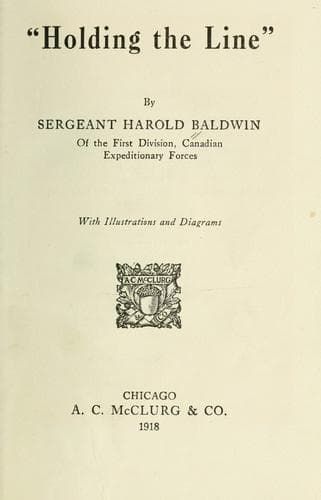
World War, 1914-1918 -- Campaigns -- Western Front; World War, 1914-1918 -- Personal narratives, Canadian
Shell fire will destroy the morale of any soldier, for when a man is
fair enough to look facts in the face, he will acknowledge that
courage is common to any nation. No nation has a monopoly of it, and
the German has his share.
In these days, perhaps, he gives in rather easily; but he is getting
hell from the Allied artillery--at least on the Western Front. And,
who knows, perhaps doubts of their ultimate triumph have begun to
assail them. I have seen them fight well with the bayonet, and a
clump on my head from a Hun no bigger than myself I well remember. I
hate to admit it, but he licked me honestly and fairly; and only his
sportsmanship saved me. He simply knocked me silly--and passed on.
I hate and loathe their barbarity--I hate them for bringing this hell
upon the world, but I am English, and as such, must give the other
fellow his due.
In my experience with their infamous deeds in Belgium and France, I
always remember two occasions when the Huns belied their name. One
of them came within range of my own experience. During our
retirement one of our men was hit in the leg, and of course fell
down. It was impossible to take him with us, for we had to get back
quickly in order to make conjunction with the other troops who had
fallen back. Much as we hated the idea, we had to leave him. That,
unfortunately, is the fate of many of the wounded when retiring. He
was taken prisoner and, naturally, we thought he had either been
bayoneted, or was on his way to Germany. Judge of our surprise, when
in billets, the man walked into our farmyard. We crowded around,
simply crazy to hear how he had hoodwinked the Germans and escaped.
We marveled when he told his story.
He had been taken by a mob of Saxon troops. He expected either death
or capture. These men, however, dressed his wound; inoculated him
against the possibility of lockjaw; placed him in a cellar with clean
straw to lie on, and when his slight wound permitted him to walk,
they allowed him to make his escape to his own lines.
Once, since I have returned, I was told a story by one of the
Princess Patricia Regiment. At a certain place in Belgium a dozen or
so of the Pats were lying behind some cover. The day was a quiet
one, and the Pats had that heavenly concoction called "char" in mind.
"Char" is tea to those unacquainted with English. They had the
wherewithal for the making of the tea with the exception of the
water. Of course there was enough lying around to float a boat, but
anyone who has smelt that "aqua vitae" would not dream of using it
for tea. When a seasoned soldier will not use it, it is pretty bad.
Public-domain text, read in full here on John Shaqi.
Reviews
Reviews
No reviews yet
Be the first to share your thoughts on this work.
Join the Discussion
Join the discussion
Sign in to leave a comment or review.
Sign InorCreate an account