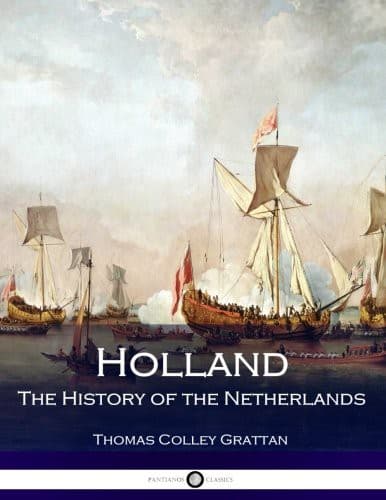
Holland: The History of the NetherlandsGrattan, Thomas Colley
History
Holland: The History of the Netherlands
Grattan, Thomas Colley
Netherlands -- History
In the midst of this gradual organization of the various counties,
history for some time loses sight of those Frisons, the maritime
people of the north, who took little part in the civil wars of
two centuries. But still there was no portion of Europe which
at that time offered a finer picture of social improvement than
these damp and unhealthy coasts. The name of Frisons extended
from the Weser to the westward of the Zuyder Zee, but not quite
to the Rhine; and it became usual to consider no longer as Frisons
the subjects of the counts of Holland, whom we may now begin
to distinguish as Hollanders or Dutch. The Frison race alone
refused to recognize the sovereign counts. They boasted of being
self-governed; owning no allegiance but to the emperor, and regarding
the counts of his nomination as so many officers charged to require
obedience to the laws of the country, but themselves obliged
in all things to respect them. But the counts of Holland, the
bishops of Utrecht, and several German lords, dignified from
time to time with the title of counts of Friesland, insisted
that it carried with it a personal authority superior to that
of the sovereign they represented. The descendants of the Count
Thierry, a race of men remarkably warlike, were the most violent
in this assumption of power. Defeat after defeat, however, punished
their obstinacy; and numbers of those princes met death on the
pikes of their Frison opponents. The latter had no regular leaders;
but at the approach of the enemy the inhabitants of each canton
flew to arms, like the members of a single family; and all the
feudal forces brought against them failed to subdue this popular
militia.
The frequent result of these collisions was the refusal of the
Frisons to recognize any authority whatever but that of the national
judges. Each canton was governed according to its own laws. If
a difficulty arose, the deputies of the nation met together on
the borders of the Ems, in a place called "the Trees of Upstal"
(_Upstall-boomen_), where three old oaks stood in the middle of
an immense plain. In this primitive council-place chieftains
were chosen, who, on swearing to maintain the laws and oppose
the common enemy, were invested with a limited and temporary
authority.
It does not appear that Friesland possessed any large towns, with
the exception of Staveren. In this respect the Frisons resembled
those ancient Germans who had a horror of shutting themselves up
within walls. They lived in a way completely patriarchal; dwelling
in isolated cabins, and with habits of the utmost frugality. We
read in one of their old histories that a whole convent of
Benedictines was terrified at the voracity of a German sculptor
who was repairing their chapel. They implored him to look elsewhere
for his food; for that he and his sons consumed enough to exhaust
the whole stock of the monastery.
Public-domain text, read in full here on John Shaqi.
Reviews
Reviews
No reviews yet
Be the first to share your thoughts on this work.
Join the Discussion
Join the discussion
Sign in to leave a comment or review.
Sign InorCreate an account