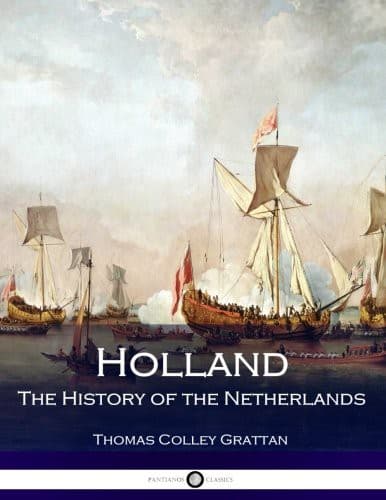
Holland: The History of the NetherlandsGrattan, Thomas Colley
History
Holland: The History of the Netherlands
Grattan, Thomas Colley
Netherlands -- History
John the Fearless succeeded in 1404 to the inheritance of all
his father's dominions, with the exception of Brabant, of which
his younger brother, Anthony of Burgundy, became duke. John, whose
ambitious and ferocious character became every day more strongly
developed, now aspired to the government of France during the
insanity of his cousin Charles VI. He occupied himself little
with the affairs of the Netherlands, from which he only desired
to draw supplies of men. But the Flemings, taking no interest in
his personal views or private projects, and equally indifferent
to the rivalry of England and France, which now began so fearfully
to affect the latter kingdom, forced their ambitious count to
declare their province a neutral country; so that the English
merchants were admitted as usual to trade in all the ports of
Flanders, and the Flemings equally well received in England,
while the duke made open war against Great Britain in his quality
of a prince of France and sovereign of Burgundy. This is probably
the earliest well-established instance of such a distinction
between the prince and the people.
Anthony, duke of Brabant, the brother of Philip, was not so closely
restricted in his authority and wishes. He led all the nobles
of the province to take part in the quarrels of France; and he
suffered the penalty of his rashness in meeting his death in
the battle of Agincourt. But the duchy suffered nothing by this
event, for the militia of the country had not followed their
duke and his nobles to the war; and a national council was now
established, consisting of eleven persons, two of whom were
ecclesiastics, three barons, two knights, and four commoners.
This council, formed on principles so fairly popular, conducted
the public affairs with great wisdom during the minority of the
young duke. Each province seems thus to have governed itself
upon principles of republican independence. The sovereigns could
not at discretion, or by the want of it, play the bloody game
of war for their mere amusement; and the emperor putting in his
claim at this epoch to his ancient rights of sovereignty over
Brabant, as an imperial fief, the council and the people treated
the demand with derision.
Public-domain text, read in full here on John Shaqi.
Reviews
Reviews
No reviews yet
Be the first to share your thoughts on this work.
Elsewhere in the archive
Join the Discussion
Join the discussion
Sign in to leave a comment or review.
Sign InorCreate an account