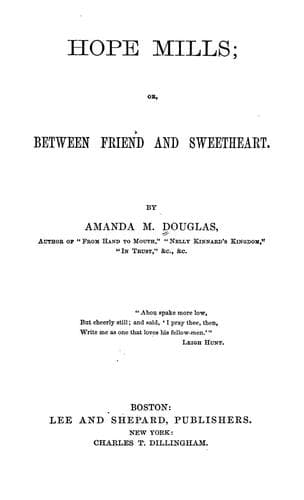
Hope Mills; Or, Between Friend and SweetheartDouglas, Amanda M.
Philosophy
Hope Mills; Or, Between Friend and Sweetheart
Douglas, Amanda M.
Fiction
There was a stormy wrangle. Meetings were held, and speakers figured out
the actual cost of living. Less than the present rates meant loss,
privation, and want in the end. So a strike was determined upon.
Jack Darcy, being foreman of one department, stood, as it were, between
the upper and nether millstone, at present just escaping both. He
thought it hard that the men should have this second reduction so soon,
and it did seem to him reasonable that profits ought to yield a little,
that there ought to be a sympathy between them. Personally, he should be
comfortable enough; but if he had a wife and three or four children, a
helpless, bedridden mother, or a drunken father, or a do-nothing
brother, hanging upon him, what then?
He advised a little moderation and patience. It might be better to take
the wages now, and wait until spring--
"They doant give up any thing, as we sees," broke in an elderly English
weaver. "The great house is full of every thing, and coal eno' burning
in the greenhouses to ripen a few bunches of grapes out of God's own
season, as would keep many of us warm. Who puts our coal down a dollar
in the ton, or takes it off of house-rent when wages come down? I'll
work as cheap as the next one if ye'll gi' me a cheap house to live in
and cheap beef and bread. I doant care for money in the savin's bank, or
a house that they tax all out o' sight. When I'm old I'll go to the
poorhouse, I will; but I'm danged if I like starvin' before then, and
they a-ridin' over us in their carriages. I left 'em over yonder"--with
a nod of the head--"for that."
"What do you think of it?" asked a thin, hungry-looking man, fingering
his Cardigan nervously. "See here! If I could have one more prosperous
year, I'd be through the woods, have the house I've worked so hard for
settled upon my old woman, and would be out of the reach of misfortune.
But this thing hits me hard, it does."
"I don't believe striking will succeed just now," said Jack candidly.
"And it's a bad time. Two or three weeks lost time will more than cover
the odds in wages."
"I don't want to lose time. I'd rather keep straight on."
"It's the principle of the thing," broke in another. "I'd lose six
months before I'd give in an inch. I'd have struck the other time."
There was a call for the overseers, and Jack left the group. Eastman was
talking to several of the men in his office. A fine, portly figure he
had, indicating rich living and good wines; a man still on the sunny
side of forty, stout, rather florid, a full dark beard and hair, but
with eyes that were light and furtive; eyes that could stare you out of
countenance, and yet not meet yours ordinarily, with a frank, outward
look. He always went handsomely dressed, and wore diamond shirt-studs,
an expensive seal-ring, a substantial watch-chain with two or three
costly charms. He had not a flashy look, but the sign and seal of
gentlemanliness was wanting in that intensely selfish face.
Public-domain text, read in full here on John Shaqi.
Reviews
Reviews
No reviews yet
Be the first to share your thoughts on this work.
Join the Discussion
Join the discussion
Sign in to leave a comment or review.
Sign InorCreate an account