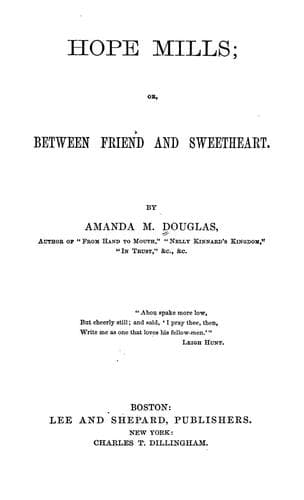
Hope Mills; Or, Between Friend and SweetheartDouglas, Amanda M.
Philosophy
Hope Mills; Or, Between Friend and Sweetheart
Douglas, Amanda M.
Fiction
"I always hated to grind workmen down to a bare subsistence," spoke the
honest, loyal gentleman, as God made him. Trade had not warped body and
soul. He was an aristocrat, if you please, and his home was as sacred to
refinement and elegance as a ducal palace. A common person would have
stood in his hall until his errand was done, and he would never even
have asked a workman to take a seat in his office; but his soul was
honorable, if haughty.
"Let me manage it," with a confident nod. "We'll keep the topmost wave,
as you will see."
So to New York Horace Eastman went, and arranged for a large
auction-sale of goods, which was a remarkable success, and created quite
a ripple in the sea of stagnation. Then he contracted to deliver another
lot by the first of January, at certain prices. And now either
manufacturer must give up profits, or workman yield his margin, and be
contented with daily bread alone.
"There really was no need of workmen owning houses, having Brussels
carpets and pianos," argued Eastman. "They were in some degree
answerable for the hard times. Every one wanted to out-do his neighbor.
They were not content to live as their fathers had lived; and, where the
mothers wore print dresses, the daughters must have silk. They had gone
on altogether too fast."
Yet only a few years ago workingmen had been urged to put their money
into homes. Rows of houses had been built for them, and sold on such
ridiculously easy terms, only a trifle down. The interest would not be
as much as rent. Then the fascinating shopkeeper had flaunted his wares
in the faces of the thrifty housewives. "A good article is cheapest in
the end. This Brussels will outwear two ingrain carpets, at a very
little advance on the first cost. No moths will trouble it, once down it
is there for years, saving worry and hard work;" and the buyer was
persuaded. Then there must be new furniture, and so on to the end. Was
it altogether their fault? The old things were passing away. The world
was awaking from its Rip-Van-Winkle nap. There was to be a wider
outlook, a liberal cultivation, a general rising of every one.
So there had been years of plenty, and men had pulled down the old
storehouses to build new ones.
Such people as the Eastmans and the Lawrences could not economize at a
moment's warning. The screws must be put on elsewhere.
At first the workmen looked at each other in blank dismay. Winter was
coming on--a hard one it bid fair to be. Coal had risen, and in spite of
the abundant harvest the absolute staples of life had not much decreased
by the time they reached the consumer. Coffees were high: pease, beans,
and chiccory were sold at a reduction, to be sure, and you could get
lumpy heavy flour that spoiled your bread, and poor butter, and teas
that were colored and doctored; and this was cheap living.
Public-domain text, read in full here on John Shaqi.
Reviews
Reviews
No reviews yet
Be the first to share your thoughts on this work.
Join the Discussion
Join the discussion
Sign in to leave a comment or review.
Sign InorCreate an account