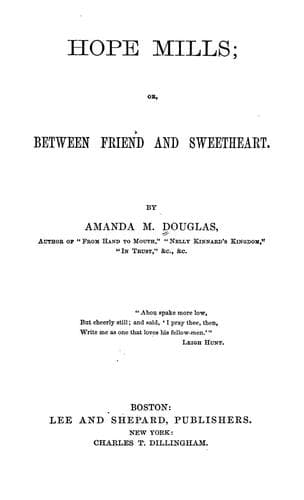
Hope Mills; Or, Between Friend and SweetheartDouglas, Amanda M.
Philosophy
Hope Mills; Or, Between Friend and Sweetheart
Douglas, Amanda M.
Fiction
What impression could he make upon this man? To appeal to conscience,
justice, or any latent sense of right, would be a waste of words. With
him success was right, and failure the blunder or sin. He was to "do
well unto himself," to gain the world's verdict of approval. That solid
flesh made by good eating and drinking, not debauchery or
intemperance,--the man had few of these gross vices,--that complacent
strength, that keen, concentrating force than could bend all energies in
the one direction, never looking back when he had once set his mind to a
thing, experiencing no remorse for those he crushed under his feet so
long as he went to success over them, knowing no disinterestedness,
trading simply upon the credulity, honor, and honesty of others: he had
chosen him for some of these very qualities. Do men gather grapes of
thistles?
"Bring the books to my office. I shall go over them to-night," was the
haughty command.
Eastman bowed and withdrew. The books were sent by the errand-boy. Then
he threw himself into his luxurious Russia-leather chair, rested his
feet upon the edge of the desk, settled his hands comfortably in his
pockets, and began to consider. A man would be foolish to stay and be
caught in the ruin of a falling house. He might not be crushed, to be
sure; but there would be the _débris_, and he had no fancy for clearing
that away. Not only the mills, but Yerbury, would fall flat. He did not
care to retire to a garden, and raise strawberries and corn: the clink
of gold was more melodious to his ear than the voices of nature. There
was a place for talent like his: the quick sight and keen discrimination
were still able to give the rusty old world a lift out of ruts it had
stopped in, and send it on with a rush. He had money in some
silver-mines: he might go West, and attend to that, then take a run over
to England, and see George. After all, was George really to blame for
getting hold of his wife's portion? He had married Miss Lawrence,
believing in good faith that she was the daughter of a millionnaire;
and, if he had been sharp enough to save something from the general
ruin, lucky for him!
On the whole, Mr. Eastman thought it would be well to go to New York for
a few days until the storm blew over. Jeffries the book-keeper could
attend to all that was needed. Mr. Lawrence would find Hope Mills in a
bad plight, to be sure; but he would not be the first man who had come
to ruin. Mr. Eastman put his desk in order,--he never kept any tell-tale
papers,--walked leisurely out of Hope Mills with that serene, impassable
face and high heart no misfortune could daunt.
Public-domain text, read in full here on John Shaqi.
Reviews
Reviews
No reviews yet
Be the first to share your thoughts on this work.
Elsewhere in the archive
Join the Discussion
Join the discussion
Sign in to leave a comment or review.
Sign InorCreate an account