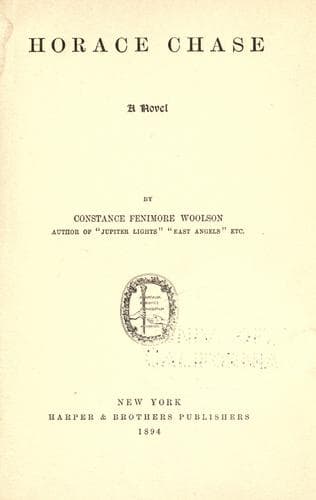
Didactic fiction; Men -- United States -- Fiction; United States -- Social life and customs -- 19th century -- Fiction
"Yes, I am beginning to understand about that, Miss Ruth; I didn't at
first. It's a great pity. Perhaps something can be done?"
"No; he can't get back into the navy now," said Ruth, sadly.
"But a change of some kind might be arranged," answered Chase, touching
the off horse.
At the base of the mountains they followed the river road again, a rocky
track, sometimes almost in the water, under towering cliffs that rose
steeply, their summits leaning forward a little as though they would
soon topple over. At many points it was a veritable canyon, and the swift
current of the stream foamed so whitely over the scattered rocks of its
bed that it was like the rapids of Niagara. Here and there were bold
islands; the forest on both sides was splendid with the rich tints of
the _Rhododendron maximum_ in full bloom; not patches or single bushes,
but high thickets, a solid wall of blazing color.
Their stopping-place for the last evening was the farm-house called
Crumb's, where they had also spent the first night of their journey on
their way westward. Crumb's was one of the old farms; the grandfather of
David Crumb had tilled the same acres. It was a pleasant place near the
river, the house comparatively large and comfortable. The Crumbs were
well-to-do in the limited mountain sense of the term, though they had
probably never had a hundred dollars in cash in their lives. Mrs. Crumb,
a lank woman with stooping shoulders and a soft, flat voice, received
them without excitement. Nothing that life had to offer, for good or for
ill, could ever bring excitement again to Portia Crumb. Her four sons
had been killed in battle in Virginia, one after the other, and the
mother lived on patiently. David Crumb was more rebellious against what
he called their "bad luck." Once a week, and sometimes twice, he went to
Asheville, making the journey a pretext for forgetting troubles
according to the ancient way. He was at Asheville now, his wife
explained, "with a load of wood." She did not add that he would probably
return with a load of another sort--namely, a mixture of whiskey and
repentance. The two never spoke of their lost boys; when they talked
together it was always about "the craps."
Public-domain text, read in full here on John Shaqi.
Reviews
Reviews
No reviews yet
Be the first to share your thoughts on this work.
Join the Discussion
Join the discussion
Sign in to leave a comment or review.
Sign InorCreate an account