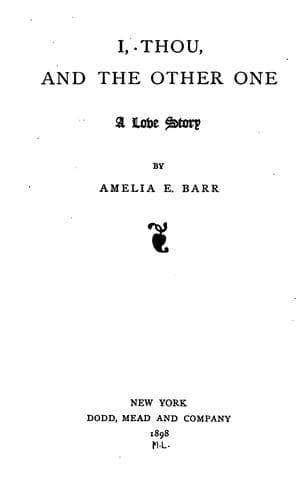
I, Thou, and the Other One: A Love StoryBarr, Amelia E.
General
I, Thou, and the Other One: A Love Story
Barr, Amelia E.
Fiction; Love stories
A feeling therefore of intense anxiety pervaded the country on the
Second of November,--the day on which the King was to open Parliament.
No one could work; every one was waiting for the King's speech. He was
as yet very popular; it was his first message to his people; and they
openly begged him for some word of hope--some expression of sympathy for
Reform. He went in great state to Westminster, and was cheered by the
city as he went. "Will Your Majesty say a word for the poor? God bless
Your Majesty! Stand by Reform!" Such expressions assailed him on every
hand; they were the prayers of a people wronged and suffering, yet
disposed to be patient and loyal, and to seek Reform only to spare
themselves and the country the ruth and ruin of Revolution.
Richmoor House was on the way of the royal procession, and Kate was there
to watch it. A little later, a great company began to assemble in its
rooms; for the Duke had promised to bring, or to send, the earliest news
of the event. There was however an intense restlessness among these
splendidly attired men and women. They could not separate Reform from
Revolution; and the French Revolution was yet red and bloody in their
memories. They still heard the thunder of those famous "Three Days of
July," and there was constantly before their eyes, the heir of forty
kings finding in a British palace an ignominious shelter. Not only was
this the case, but French noblemen, in poverty and exile, were earning
precarious livings all around; and English noblemen and ladies looked
forward with terror to a similar fate, if the Reformers obtained their
desire. Indeed, Sir Robert Inglis had boldly prophesied, "Reform would
sweep the House of Lords clear in ten years."
No wonder then the company waiting in Richmoor House were restless and
anxious. Kate did not permit herself to speak, and Mrs. Atheling had
very prudently remained in her own home. She had told the Squire she
"must say what she thought, if she died for it!" and the Squire had
answered, "To be sure, Maude. That is thy right; only, for goodness'
sake, say it in thy own house!" But though Kate knew she would follow
her mother's example, if she was brought to catechism on the subject,
she did not have much fear of such a result; there were too many older
ladies present, all of them desirous to express the hatreds and hopes
of their class.
Public-domain text, read in full here on John Shaqi.
Reviews
Reviews
No reviews yet
Be the first to share your thoughts on this work.
Elsewhere in the archive
Join the Discussion
Join the discussion
Sign in to leave a comment or review.
Sign InorCreate an account