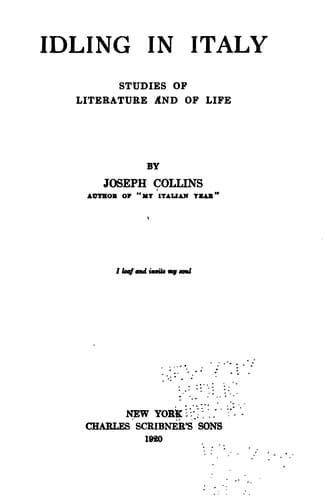
Idling in Italy: Studies of literature and of life — John Shaqi
Idling in Italy: Studies of literature and of lifeCollins, Joseph
History
Idling in Italy: Studies of literature and of life
Collins, Joseph
Italian literature -- History and criticism
Aldo Palazzeschi (1885-) is one of the youngest of the Futuristic group
who has gained enduring fame as a poet. His first volume of verses,
"Cavalli Bianchi" ("White Horses"), which was published when he was
twenty years old, showed him to be a youth of sensibility and
originality, with capacity for tuneful verse and for dainty sentiment
daintily expressed. The publication of a second volume, entitled
"Lanterna" ("The Lantern"), two years later, fully justified the
expectations of those who were attracted by the little gems of his early
verse. But it was not until 1909, on the publication of a volume
entitled "The Poems of Aldo Palazzeschi," that it was realized that
there had come upon the scene a poet who might quite easily get a fame
equal to that of Carducci or Pascoli.
His poems not only showed the influence of Apollinaire and Marinetti,
but also of Whitman, of Mallarmé, of Rimbaud, of Laforgue, and of other
French writers. The dyed-in-the-wool critics saw in much of his work
clownishness and infantilism, especially in such productions as "E
lasciatemi divertire." They thought it should be construed: "And let me
divert myself with insane-asylum poetry." They were quite right from
their standpoint, but a fellow poet whose emotional mechanism is not so
equilibrated as that of the sort of man called normal, would be likely
to see in it something of beauty and of merit which the latter could not
see, and ask: "Why should not the poet divert himself?" It is to him
what exercise is to the average man, and he speaks of it, in fact is
proud of it, just as the average man is proud of his golf score when he
gets it in that Elysian field, "under ninety."
Those who do not see in Palazzeschi's poetry an adhesion to a certain
school of philosophy, an advocacy of certain ethical systems, a
restatement of others' thoughts and teachings, miss the very essence of
his contribution. This is his capacity to present the world around us in
colors which, if not new, at least have been recognized only since the
advent of the impressionistic painter. So illuminated, it presents
facets of beauty that make appeal to that which within us mediates and
interprets pleasure.
In addition to this, he has an extraordinary sense of the fantastic, the
grotesque, the panoplied. His eye is microscopic and his mind is
telescopic, and his soul waves tend to a rhythm which is akin to that of
genius when he reveals them and describes them to others, as he does,
for instance, in the "Villa Celeste" ("The Celestial House"); the
average man (who is attuned to interpret some poetic waves) realizes
that the soul of this young man is the generating station of genuine
poetical energy. He puts a reflector before his soul and it reflects the
waves in our direction.
"Io metto una lente
dinanzi al mio cuore,
per farlo vedere alla gente."
Public-domain text, read in full here on John Shaqi.
Reviews
Reviews
No reviews yet
Be the first to share your thoughts on this work.
Join the Discussion
Join the discussion
Sign in to leave a comment or review.
Sign InorCreate an account