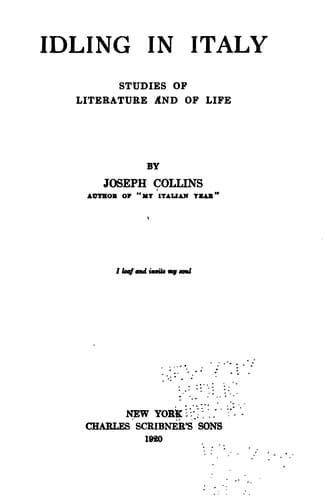
Idling in Italy: Studies of literature and of lifeCollins, Joseph
History
Idling in Italy: Studies of literature and of life
Collins, Joseph
Italian literature -- History and criticism
In 1911 he issued a volume entitled "Electric Poetry" ("Poesie
elettriche"), whose futurist cover was the only futuristic feature it
had. There is no humming, puffing, whirring to convey that
steam-and-gasoline-engine modernity which it should have in order to
justify the name. Its lines are too refined, too pussy-foot, too
pathetic, too tender-minded for that. Were it not for the perfect
equality of the sexes to-day we would be tempted to say they had a
feminine quality. Daintiness does not express it; neither does unvirile.
There is none of this quality in his next production--the "Hymn on the
Death of Sergio." "Neve" ("The Snow") appeared in 1914; "Rarefazione"
("Rarefactions") in 1915. The latter is a weird collection of childish
figures designed by the poet and commented upon by him to such effect as
to demonstrate a state of latent infantilism. In the same year he
published a volume entitled "The Inauguration of the Spring"
("L'Inaugurazione della Primavera"), which contains most of Govoni's
best work in poems. His last book, a series of short stories, "La Santa
Verde" ("The Ardent Saint"), adds nothing to his fame. Most of them are
insignificant, colorless, reliefless, purposeless.
An attempt has been made by champions of Corrado Govoni to show that
"Base rivals, who true wit and merit hate" are forming a cabal to
prevent his getting his deserts. Fiumi, his last champion, does not
materially advance his claim.
Such, in all their diversity, are the Futurists. There is no common
formula which describes them. They have a programme which, like that of
the Socialists, must from its very nature lack specificity. They are not
very definitely organized and many who enrolled under their banner in
the enthusiasm of youth soon deserted the cause. But meanwhile they got
sufficient inspiration and impetus to throw off the shackles of
tradition and to taste the pleasure of exploration. More often they get
purged of a kind of literary preciosity which makes for their well-being
and usefulness. The programme of the Futurist is of little importance in
itself, but it is of great importance as a symptom of tendencies now
agitating the minds of the younger generation in Italy. It may be that
their efforts will constitute the small end of the wedge by which
Romanticism and Verism shall be burst asunder like the Dragon of Bel's
Temple.
CHAPTER V
GIOVANNI PAPINI AND THE FUTURISTIC LITERARY MOVEMENT IN ITALY
In one of his "Appreciations"--depreciations would be the more fitting
word--Signor Papini says he seems to have read or to have said that in
every man there are at least four men: the real man, the man he would
like to be, the man he thinks he is, and the man others think he is. He
is sure to have read it, for he has read widely. Undoubtedly he has also
said it, for he has made a specialty of saying things that have been
said before--even that he has said before.
Public-domain text, read in full here on John Shaqi.
Reviews
Reviews
No reviews yet
Be the first to share your thoughts on this work.
Join the Discussion
Join the discussion
Sign in to leave a comment or review.
Sign InorCreate an account