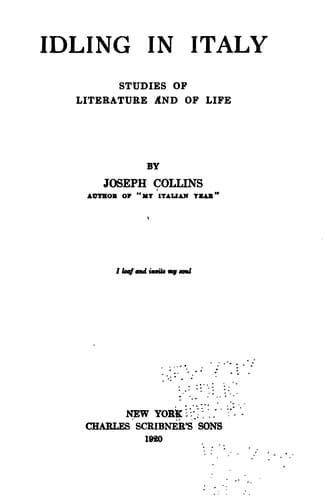
Idling in Italy: Studies of literature and of lifeCollins, Joseph
History
Idling in Italy: Studies of literature and of life
Collins, Joseph
Italian literature -- History and criticism
Although his early writings had an arresting quality, it was not until
he undertook to edit some Italian classics published under the title of
"I Nostri Scrittori" ("Our Writers") that they began to take on the
features that have since become characteristic and which have been
described by his admirers as "rugged, vigorous, virile, rich,
neologistic," and everything else the antithesis of pussy-foot. This
feature, if feature it can be called, showed itself first in "L'Uomo
Finito," a book which is admitted to be an autobiography. It introduces
us to an ugly, sensitive, introspective, mentally prehensile child of
shut-in personality who is not only egocentric at seven but who loves
and exalts himself and despises and disparages others.
This unlovable child with an insatiate appetite for information found
his way to a public library and determined to write an encyclopædia of
all knowledge. His juvenile frenzy came its first cropper when he
reached the letter "B," and he was submerged with the Bible and with
God. The task was too big, he had to admit, but his ambition to
accomplish some great and thorough piece of work was undaunted. He began
a compendium of religions, then of literature, and last of the Romance
languages.
These successive attempts at completeness are typical of Papini's
far-reaching ambitions. "The Played-Out Man" is a record of his plunge
into one absorption after another. He discovered evil, and planned not
only individual suicide but suicide of the people _en masse_. Next came
the desire for love. His instincts were of a sort not to be satisfied by
the conventional sweetness of "I Promessi Sposi," but from Poe, Walt
Whitman, Baudelaire, Flaubert, Dostoievsky, and Anatole France he got a
vicarious appeasement of the sentiment he craved. Then he encountered
"dear Julian." "We never kissed each other and we never cried together,"
but he could not forgive Julian for allowing his friend to learn of his
matrimony only through the _Corriere della Sera_.
The brief emotional episode past, Papini's life interest swung back to
philosophy. He discovered Monism, and believed it like a religion. Then
Kant became his ideal, then Berkeley, Mill, Plato, Locke, culminating in
the glorified egotism of Max Stirner. After Stirner philosophy has no
more to say. Down with it all! It is necessary to liberate the world
from the yoke of these mumblers, just as Papini has liberated himself.
But how to do it! Ah, yes! Found a journal that will purge the world of
its sins, as the Great Revolution purged France of royalty.
Public-domain text, read in full here on John Shaqi.
Reviews
Reviews
No reviews yet
Be the first to share your thoughts on this work.
Elsewhere in the archive
Join the Discussion
Join the discussion
Sign in to leave a comment or review.
Sign InorCreate an account