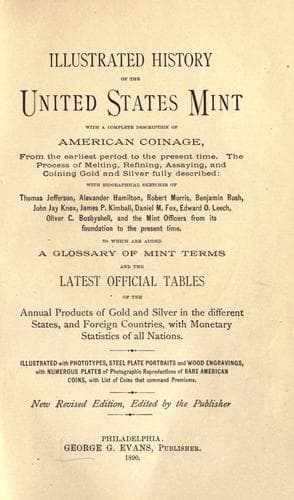
Illustrated history of the United States mint: with a complete description of American coinage, from the earliest period to the present time
History
Illustrated history of the United States mint: with a complete description of American coinage, from the earliest period to the present time
Coinage -- United States; Mints -- United States
The semi-official coins of the Pacific coast present quite a glittering
array of monetary enterprise, and signify the great wealth and daring
spirit of that part of the world. The fifty-dollar octagon gold piece,
issued in 1851, is a very beautiful coin. “Gold slugs” are novelties;
are oblong gold pieces, and are valued at sixteen dollars. The Utah
coins also attract attention. They are of gold, fine. The device is an
“all-seeing eye” and two clasped hands; reverse, “a bee-hive,” with
inscription, “Holiness to the Lord.” Some have for legend, “G. S. L. C.
P. G.,” which the initiated receive as “Great Salt Lake City, Pure Gold.”
The series of the United States coins is complete, and can be readily
examined. The changes have been very gradual. The motto, “In God we
trust,” was introduced in 1866.
There is one specimen which illustrates how a coin may become famous
without the least premonition, and also is a witness of the positive
law which protects and governs coinage. A law passed Congress in 1849
ordering twenty-dollar gold pieces to be issued. One piece was struck.
Something intervened to delay the work, and the year closed; then, of
course, the dies had to be destroyed, as no more could be lawfully issued
of 1849. The coin just beside this, marked 1850, of same value, is not
worth the collector’s consideration, while “1849” cannot to be purchased.
It is marked “unique,” and is really the only one in gold. One specimen
exists in brass.
COINS OF THE SOUTHERN CONFEDERACY.
It has been said and repeated as a historical fact that the Southern
Confederacy had no metallic currency. After a lapse of eighteen years
the following official document from the Confederate archives explains
itself, and substantiates the fact that silver to a limited extent was
coined at the New Orleans Mint by order of the Confederate Government, in
the early days of the rebellion, and only suspended operations on account
of the difficulty in obtaining bullion for coinage.
WAR DEPARTMENT,
ADJUTANT GENERAL’S OFFICE,
WASHINGTON, _March 27, 1879_.
DR. B. F. TAYLOR, _New Orleans, La._
DEAR SIR:—The enclosed circular will explain to you the nature
of the duties upon which I am now engaged; I would like to have
from you, from file with confederate archives, a letter stating
when you were appointed Chief Coiner of the Confederate States
Mint, instructions received copies of the originals of any
official papers, sketches, descriptions, etc., of all the coins
made, etc. This will make a valuable addition to Confederate
history, and I know no one but you can give it.
Very truly yours,
MARCUS J. WRIGHT.
NEW ORLEANS, LA., _April 7, 1879_.
TO HON. MARCUS J. WRIGHT.
Public-domain text, read in full here on John Shaqi.
Reviews
Reviews
No reviews yet
Be the first to share your thoughts on this work.
Join the Discussion
Join the discussion
Sign in to leave a comment or review.
Sign InorCreate an account