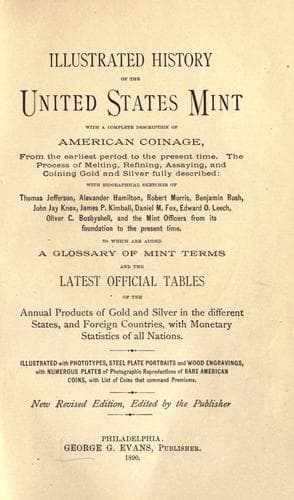
Illustrated history of the United States mint: with a complete description of American coinage, from the earliest period to the present time
History
Illustrated history of the United States mint: with a complete description of American coinage, from the earliest period to the present time
Coinage -- United States; Mints -- United States
The first copper coins made by the United States Mint were one cent and
one-half cent issues, of which there were four designs: 1st, the “chain
cent;” 2d, the “wreath cent;” 3d, the “flowing hair;” and 4th, the
“liberty cap,” which was used for a number of years. The “chain” device
was not acceptable to the sensitive American mind, and of consequence the
accidental breaking of the die was not a subject of regret, but “quite
the contrary.” The pattern sections of United States coins are very
beautiful and varied, especially those in gold.
THE TRADE DOLLAR.
This coin bears on the obverse a female figure seated on bales of
merchandise, holding in her left hand a scroll on which is the word
“liberty.” At her back is a sheaf of wheat; this and the bales of goods
indicate the commercial character of the coin. Her right hand, extended,
offers the olive branch. On a scroll beneath the figure are the words “In
God we trust,” and the date below, “1873.” The reverse has a circling
inscription, “United States of America, Trade Dollar.” In the centre is
an eagle, in his claws three arrows and a sprig of olive. On a label
above are the words “E Pluribus Unum.” Below, “420 grains fine,” very
beautiful in design.
HISTORY OF THE TRADE DOLLAR.
The coinage of the Trade Dollar was authorized by act of February 12,
1873, and was not intended for circulation in the United States, but for
export to China.
It was designed to compete with the Spanish and Mexican dollar. That
empire, having no mint for the coinage of gold or silver, depended upon
foreign coin for its domestic circulation, and until the institution of
the Trade Dollar the principal shipments of coin to China were in the
form of Mexican dollars.
The Trade Dollar was made a trifle more valuable than the American and
Mexican dollar, thus not only affording a market for the surplus silver
of the mines of the Pacific Coast, but furnishing merchants and importers
from China with silver in a convenient form for payment for commodities,
instead of their being obliged to purchase Mexican dollars for that
purpose.
When its coinage was authorized it was inadvertently made a legal tender
to amount of five dollars, but this was repealed by section 2, Act of
July 22, 1876.
BRIEF HISTORY OF THE STANDARD SILVER DOLLAR.
Authorized to be coined, Act of April 2, 1792. Weight, 416 grains,
standard silver; fineness, 892.4; equivalent to 371¼ grains of fine
silver, with 44¾ grains alloy of pure copper.
Weight changed, Act of January 18, 1837, to 412½ grains, and fineness
changed to 900, preserving the same amount of pure silver = 371¼ grains,
with ⅒ alloy.
Coinage discontinued, Act of February 12, 1873.
Total amount coined, from 1792 to 1873, $8,045,838.
Coinage revived, two million dollars per month required to be coined,
and issue made legal tender for all debts, public and private, Act of
February 28, 1878.
Total amount coined, February 28, 1878, to November 1, 1884, $184,730,829.
PACIFIC COAST.
Public-domain text, read in full here on John Shaqi.
Reviews
Reviews
No reviews yet
Be the first to share your thoughts on this work.
Join the Discussion
Join the discussion
Sign in to leave a comment or review.
Sign InorCreate an account