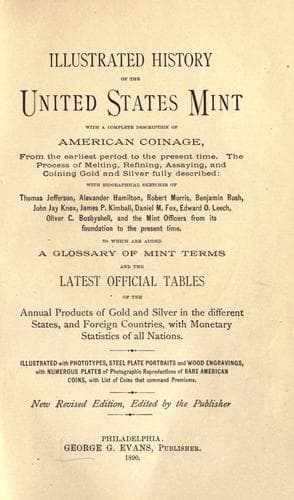
Illustrated history of the United States mint: with a complete description of American coinage, from the earliest period to the present time
History
Illustrated history of the United States mint: with a complete description of American coinage, from the earliest period to the present time
Coinage -- United States; Mints -- United States
Reverse: Same in general as the Cent of 1787, except that the shield upon
some specimens, bears only “HALF CENT.” Borders, milled; edge plain;
size, 15 to 15½; weight, 75 to 83 grains.
The “Cent,” 1788. Twelve Types. Thirteen Varieties.
MASSACHUSETTS CENT, 1788.
Obverse: A clothed Indian, standing, facing left, in his right hand a
bow, in his left an arrow. Legend: “COMMONWEALTH.”
Reverse: A spread eagle, a broad shield upon his breast, six pales gules
(upright), a chief azure (open or plain). Upon the chief, or upper part
of the shield, the word “CENT,” in bold Roman lettering. In exergue,
beneath a heavy horizontal bar, the date 1787. Borders, milled; edge,
plain; size, 16½ to 19; weight, 146 to 165 grains.
FUGIOS OR FRANKLIN CENTS.
The Fugios or Franklin Cents are the earliest coins issued by authority
of the United States. They being all dated 1787, and made in conformity
with resolution of Congress, dated July 6, 1787:
“_Resolved_, That the Board of Treasury direct the contractor for the
copper coinage to stamp on one side of each piece the following devices,
viz.: Thirteen circles linked together, a small circle in the middle,
with the words ‘UNITED STATES’ round it, and in the centre the words, ‘WE
ARE ONE’; on the other side of the same piece the following device, viz.:
a dial with the hours expressed on the face of it; a meridian sun above,
on one side of which is to be the word ‘FUGIO,’ and on the other the year
in figures ‘1787’; below the dial the words ‘MIND YOUR BUSINESS.’”
THE BAR CENT, OR U S A COPPER.
This coin, presumed to have belonged to the same issue as the Nova
Constellatio Coppers, was probably made in Birmingham, England, by
Thomas Wyon, for circulation in America. The “U S A” Copper was first
passed as money in the City of New York, in November, 1785. The device
was taken from an old Continental button, to which fact and the light
weight of the piece, has been attributed the disfavor shown the coinage
and the limited circulation given the same.
Obverse: Large Roman “U S A” in a monogram, on a plain field.
Reverse: Thirteen horizontal bars. Border, serrated; Edge, plain; size,
15½; weight, 85 grains. Two pairs of dies.
MARYLAND PENNY.
The Maryland Penny. One Type. One Variety. Unique.
Obverse: Similar to that of the sixpence.
Reverse: A Ducal Coronet, upon which are erected two masts, each bearing
a flying pennant. Legend: “DENARIVM TERRE-MARIÆ.” Copper; size, 13.
The only specimen of this piece extant was imported into America from
England, at a cost of £75, and was sold for $370 with the collection of
J. J. Mickley, Esq., of Philadelphia.
ROSA AMERICANA HALF-PENNY, 1722.
Obverse: Laureated head of King George I, facing right. Legend: “GEORGIUS
DEI GRATIA REX.”
Reverse: A full double rose; from this project five barbed points.
Legend: “ROSA AMERICANA UTILE DULCI 1722” which encircles the piece.
Border, beaded; edge, plain; “Bath Metal;” size, 16 to 18; weight, 139
grains.
Public-domain text, read in full here on John Shaqi.
Reviews
Reviews
No reviews yet
Be the first to share your thoughts on this work.
Elsewhere in the archive
Join the Discussion
Join the discussion
Sign in to leave a comment or review.
Sign InorCreate an account