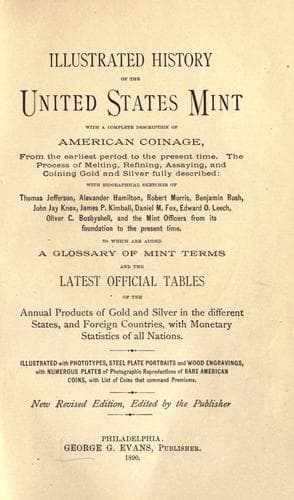
Illustrated history of the United States mint: with a complete description of American coinage, from the earliest period to the present time
History
Illustrated history of the United States mint: with a complete description of American coinage, from the earliest period to the present time
Coinage -- United States; Mints -- United States
Obverse: A classical bust of Washington, undraped, facing right; the head
is encircled by a fillet, confining the hair, which is cut short and is
curly; the fillet is tied at the back of the head by a bow knot with long
pendent ends. Legend: “WASHINGTON PRESIDENT 1792.”
Reverse: A small eagle, displayed, wings upraised; on his breast a shield
argent, six pales gules; right talon, an olive branch, fourteen leaves,
six berries; left talon, thirteen arrows; about the head of the eagle are
six mullets, and above is the word “CENT.” Border, milled; edge, plain,
or inscribed: “UNITED STATES OF AMERICA.” Size, 19; weight, 198 grains.
Some six or eight specimens only are known.
NON DEPENDENS STATUS.
Obverse: A full bust, facing right; flowing hair to the shoulders. Upon
the drapery of the bust a small oval shield as an epaulet, emblazoned
with a staff bearing a flag; across the staff, saltierwise, rests a naked
sword. In each angle of this device is displayed a fleur de lis. Upon the
breast of the bust is a head with spreading wings. Legend: “NON-DEPENDENS
STATUS.”
Reverse: An Indian, seated upon a globe, facing left; nude, except a cap
or bandeau upon his head, and a feather tunic around the lower part of
the body. In his extended right hand he holds a bunch of tobacco; the
left reaches behind him and rests upon a shield, bearing the same emblems
displayed upon the epaulets upon the bust on the obverse. Legend: “AMER
ICA,” divided by the figure of the Indian. Exergue: 1778. Border, plain;
edge plain; size, 19.
Some coin dealers advertise the Non Dependens Status as “a rare copper,
worth $100.”
PATTERN CENT, 1792.
Obverse: A bust of Liberty, facing to right, the hair confined by a
fillet. Above is inscribed the word “LIBERTY,” and beneath the date
“1792.”
Reverse: A portion of a globe, on which stands an eagle, with raised
wings. Legend: “UNITED STATES OF AMERICA.” This cent has a grained edge,
like the cents of 1793. Some numismatists give it the preference as the
first cent.
GEORGE CLINTON COPPER, 1787.
The George Clinton Copper has the bust of Governor Clinton facing right,
with legend “GEORGE CLINTON.”
Reverse: The State arms of New York, and in the exergue, “1787
EXCELSIOR.” This last reverse is found also combined with the Liber
Natus, which has an Indian standing, facing left, with tomahawk in the
right hand and bow in the left, a bundle of arrows also at his back.
Legend: “LIBER NATUS LIBERTATEM DEFENDO.” This latter obverse is also
found combined with another reverse, as follows: An eagle stands upon a
section of the globe. Legend: “NEO EBORACUS 1787 EXCELSIOR.”
[Illustration: PLATE VII.
GEORGE CLINTON COPPER. 1787.
KENTUCKY TOKEN.
IMMUNIS COLUMBIA. 1787.
MASSACHUSETTS PINE TREE SHILLING. 1652.
CHAIN CENT. 1793.
MYDDELTON TOKEN.
See description.]
[Illustration: PLATE VIII.
GREEK EGYPTIAN COIN. PTOLEMÆUS SOTER. 285-300 B. C.
ROMAN COIN. FAUSTINA, DAUGHTER OF ANTONINUS PIUS, WIFE OF MARCUS
AURELIUS. DIED, 175 A. D.
Public-domain text, read in full here on John Shaqi.
Reviews
Reviews
No reviews yet
Be the first to share your thoughts on this work.
Elsewhere in the archive
Join the Discussion
Join the discussion
Sign in to leave a comment or review.
Sign InorCreate an account