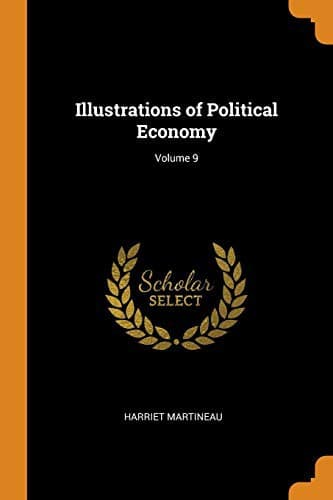
Illustrations of political economy, Volume 9 (of 9)Martineau, Harriet
General
Illustrations of political economy, Volume 9 (of 9)
Martineau, Harriet
Didactic fiction, English; Political fiction, English; Social problems -- Fiction
The weather was most disagreeable,—bitterly cold, with a fog, irritating
alike to the windpipe, the vision, and the temper. The glow-worm lamps,
with each its faint green halo, lost their use among the moving lights
that perplexed the middle of the street. Jane had judged rightly this
time in wishing to walk; for the groping on the foot-way was undoubtedly
a less evil than the confusion of carriages. The occasional backing, the
frequent clash, the yells, the oaths of the drivers, and now and then
the snorting of a frightened horse, and the groans of a wounded one,
showed that riding in a carriage is not always the extremity of bliss
that some little children believe it to be. Henry held his sister’s arm
tight within his, and she held her peace no less tenaciously while they
were every moment walking point blank up against a broad man, or a
slender lamp-post, or innocently knocking down a wearied woman, or a
child who was tracing his mother’s apron upwards in hopes of at length
finding her hand. After a while, it struck Jane that this was a case in
which the longest way about would prove the nearest way home. By
striking down one of the small streets leading to the river, they might
escape all the carriages, and most of the people, and get to Budge Row
all the sooner for making a small circuit. She believed she could engage
not to lead her brother into the river; which was the chief peril in
this path.
“I think there is an opening to the left, here, Jane.”
“Which way does the fog drift? I think there is a draught from the
right, from the west.”
“Nay: surely it comes in our faces. No matter! you shall not go a step
farther till I have made out whether we cannot now turn eastwards. Do
stand still a moment.”
While he was down on his knees, poring over the pavement, to see which
way the stones were laid, Jane observed that it was a shame they had no
more light from the lamps, as they paid for the great new improvement in
lighting,—viz: adding two threads to each burner.
“It is no fault of any one’s,” said Henry. “We may go on thickening
wicks till we use up all our cotton, and we shall make no progress in
lighting. We must make out some new principle.”
“What principle?”
“O, if I knew, I should not have left it to be told now. All I know is
that our streets are not perfectly lighted, and so I conclude that some
better principle remains to be discovered. That is all.”
“All!” thought Jane. “I think it means much;—every thing,” she continued
within herself, while rapidly following out the clew afforded by this
simple act of faith of her brother’s.
Public-domain text, read in full here on John Shaqi.
Reviews
Reviews
No reviews yet
Be the first to share your thoughts on this work.
Join the Discussion
Join the discussion
Sign in to leave a comment or review.
Sign InorCreate an account