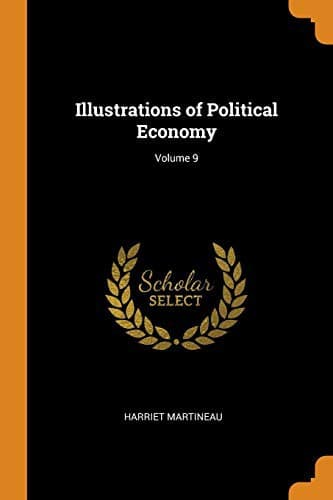
Illustrations of political economy, Volume 9 (of 9)Martineau, Harriet
General
Illustrations of political economy, Volume 9 (of 9)
Martineau, Harriet
Didactic fiction, English; Political fiction, English; Social problems -- Fiction
“Very remarkable!” was all that Henry said before he relapsed into
reverie. He roused himself, and snatched up his hat, assuring his wife,
however, that it was yet, he believed, too early for him to obtain
access to her father, or justice on his behalf. He had not proceeded far
down stairs when he was met by three gentlemen, who requested two
minutes’ conversation with him. They came to invite him to be present at
a meeting to be held for the purpose of declaring attachment to the
constitution.
“Impossible, gentlemen. You are not aware that my only brother died
suddenly last night. I cannot appear needlessly in public to-day.”
And he would have bowed them out; but they had something more to say
than condolence. As his attending the meeting was thus unfortunately
rendered impossible, perhaps he would sign the address to his Majesty.
“That will depend on what it contains. I own I do not see the immediate
occasion for such a protestation; but if the address should express what
I think and feel, I shall have no objection to put my name to it.”
The spokesman conceived that, as every true Englishman must be attached
to the constitution, there could be no risk to any true Englishman in
engaging to declare his attachment.
“Certainly, sir, if we were all agreed as to what the constitution is;
but this is the very point on which men differ. One person thinks that a
dozen or two of trials and transportations of ignorant and educated men
for sedition, and a doubling of the taxes, and an overawing of the House
of Commons, are measures of support to the constitution; while others
consider them as violations. Therefore I must fully understand what is
involved in the address before I sign it; and can, in the mean time,
pledge myself to nothing, gentlemen.”
The visitors looked at one another, and departed,—one sighing, another
giggling, and the third looking back till the last moment,—like a child
who is bidden to look at a traitor, and almost expects to see him turn
into some rare animal,—a Turk or an ourang-outang.
This time Henry got as far as the house-door. There he was turned back
by the commissioners who were employed in making the returns for the
income tax. In vain Henry assured them that he had hitherto had no
income, and that, as soon as he could ascertain whether he was to have
any of his brother’s money, and how much, he would let the gentlemen
know. They were not content with assertions given in the street, and, as
Henry had no doubt of finally satisfying them in two minutes, he invited
them up stairs.
“You are aware, sir, that we are sworn to the most inviolable secrecy as
to the affairs of individuals; that we are empowered, when dissatisfied,
to call for written explanations of the resources of living, and even to
impose an oath, if necessary.”
Public-domain text, read in full here on John Shaqi.
Reviews
Reviews
No reviews yet
Be the first to share your thoughts on this work.
Join the Discussion
Join the discussion
Sign in to leave a comment or review.
Sign InorCreate an account