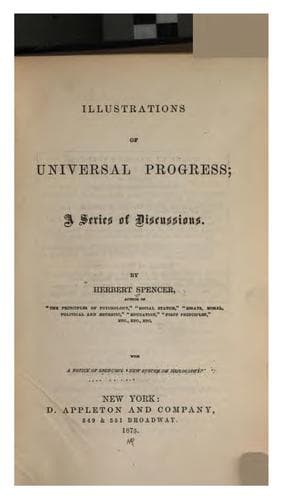
Illustrations of Universal Progress: A Series of DiscussionsSpencer, Herbert
Philosophy
Illustrations of Universal Progress: A Series of Discussions
Spencer, Herbert
Philosophy; Political science; Science
Still stronger becomes the probability of this view when we call to mind
the fact, that the same germ may be evolved into different forms according
to circumstances. Thus, during its earlier stages, every embryo is
sexless--becomes either male or female as the balance of forces acting upon
it determines. Again, it is a well-established fact that the larva of a
working-bee will develop into a queen-bee, if, before it is too late, its
food be changed to that on which the larvae of queen-bees are fed. Even more
remarkable is the case of certain entozoa. The ovum of a tape-worm, getting
into its natural habitat, the intestine, unfolds into the well-known form
of its parent; but if carried, as it frequently is, into other parts of the
system, it becomes a sac-like creature, called by naturalists the
_Echinococcus_--a creature so extremely different from the tape-worm in
aspect and structure, that only after careful investigations has it been
proved to have the same origin. All which instances imply that each advance
in embryonic complication results from the action of incident forces upon
the complication previously existing.
Indeed, we may find _a priori_ reason to think that the evolution proceeds
after this manner. For since it is now known that no germ, animal or
vegetable, contains the slightest rudiment, trace, or indication of the
future organism--now that the microscope has shown us that the first
process set up in every fertilized germ, is a process of repeated
spontaneous fissions ending in the production of a mass of cells, not one
of which exhibits any special character: there seems no alternative but to
suppose that the partial organization at any moment subsisting in a growing
embryo, is transformed by the agencies acting upon it into the succeeding
phase of organization, and this into the next, until, through
ever-increasing complexities, the ultimate form is reached. Thus, though
the subtilty of the forces and the slowness of the results, prevent us from
_directly_ showing that the stages of increasing heterogeneity through
which every embryo passes, severally arise from the production of many
changes by one force, yet, _indirectly_, we have strong evidence that they
do so.
Public-domain text, read in full here on John Shaqi.
Reviews
Reviews
No reviews yet
Be the first to share your thoughts on this work.
Join the Discussion
Join the discussion
Sign in to leave a comment or review.
Sign InorCreate an account