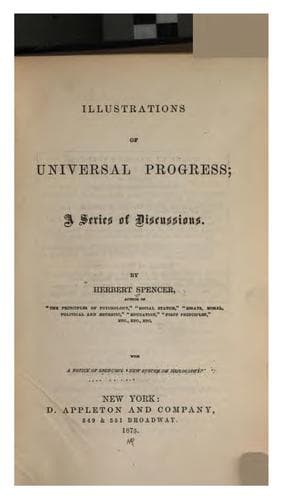
Illustrations of Universal Progress: A Series of Discussions — John Shaqi
Illustrations of Universal Progress: A Series of DiscussionsSpencer, Herbert
Philosophy
Illustrations of Universal Progress: A Series of Discussions
Spencer, Herbert
Philosophy; Political science; Science
We have marked how multitudinous are the effects which one cause may
generate in an adult organism; that a like multiplication of effects must
happen in the unfolding organism, we have observed in sundry illustrative
cases; further, it has been pointed out that the ability which like germs
have to originate unlike forms, implies that the successive transformations
result from the new changes superinduced on previous changes; and we have
seen that structureless as every germ originally is, the development of an
organism out of it is otherwise incomprehensible. Not indeed that we can
thus really explain the production of any plant or animal. We are still in
the dark respecting those mysterious properties in virtue of which the
germ, when subject to fit influences, undergoes the special changes that
begin the series of transformations. All we aim to show, is, that given a
germ possessing these mysterious properties, the evolution of an organism
from it, probably depends upon that multiplication of effects which we have
seen to be the cause of progress in general, so far as we have yet traced
it.
When, leaving the development of single plants and animals, we pass to that
of the Earth's flora and fauna, the course of our argument again becomes
clear and simple. Though, as was admitted in the first part of this
article, the fragmentary facts Palaeontology has accumulated, do not clearly
warrant us in saying that, in the lapse of geologic time, there have been
evolved more heterogeneous organisms, and more heterogeneous assemblages of
organisms, yet we shall now see that there _must_ ever have been a tendency
towards these results. We shall find that the production of many effects by
one cause, which, as already shown, has been all along increasing the
physical heterogeneity of the Earth, has further involved an increasing
heterogeneity in its flora and fauna, individually and collectively. An
illustration will make this clear.
Public-domain text, read in full here on John Shaqi.
Reviews
Reviews
No reviews yet
Be the first to share your thoughts on this work.
Join the Discussion
Join the discussion
Sign in to leave a comment or review.
Sign InorCreate an account