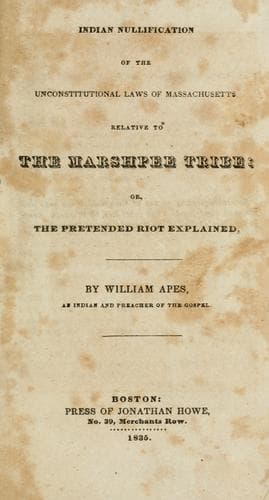
Indian Nullification of the Unconstitutional Laws of Massachusetts Relative to the Marshpee Tribe: Or, the Pretended Riot ExplainedApess, William
History
Indian Nullification of the Unconstitutional Laws of Massachusetts Relative to the Marshpee Tribe: Or, the Pretended Riot Explained
Apess, William
Indians of North America -- Legal status, laws, etc.; Mashpee Indians -- Land tenure; Mashpee Indians -- Legal status, laws, etc.
Mr. H. Lincoln of Boston, was surprised to hear an objection
raised to the reading of this petition. It was due to the
character of the House, and to our native brethren the
petitioners, whose agents were here on the floor, that they
should be heard, and heard patiently. He hoped that out of
respect to ourselves, and from justice to the petitioners,
their petition would find every favor, which in justice ought
to be extended to it.
Mr. Swift of Nantucket, again urged that the petition ought
not to be read, until the report from the Governor and Council
was first heard.
Mr. Chapman.--The petitioners have a constitutional right to
be heard. I know not of what value that provision is which
gives a right to petition, if the House can refuse to hear the
petition. They do not ask for action, but to be heard. It can
be read and laid on the table. So long as I hold a seat in
this House, my hand shall be raised to give a hearing to the
humblest individual who presents a petition for redress of
grievances.
Mr. Loring of Hingham hoped the idea could not be entertained
that they wished to throw this subject out of the House. He
wanted the whole subject should be brought up, and not that
this petition should go in first. It was not his wish to
prevent the petitioners being heard.
The Speaker put the question, shall the petition be read? and
it was carried in the affirmative, nearly every hand in the
House being raised. In the negative we saw but five hands. The
petition was then read by the Speaker.
Mr. Roberts of Salem moved that it be laid on the table and
printed for the use of the House, as there must be a future
action of the House upon it. The motion was carried without
objection.
The attempt to prevent the petition of the Marshpee Indians
from being read, was repelled in the House with an unanimity
which shows the value the Representatives place upon the right
of petitioning. The poor Indians are without advice or counsel
to aid them, for they have no means to fee lawyers, but they
will evidently find firm friends in the House ready to do them
justice. This is no party question. It involves the honor of
the State. Let all be done for them that can be wisely done
in a spirit of paternal kindness. Let it not be shown that our
sympathy for Indians extends only to those at the South, but
has no feeling for our own.
* * * * *
[_From the same_.] THE MARSHPEE INDIANS.
Public-domain text, read in full here on John Shaqi.
Reviews
Reviews
No reviews yet
Be the first to share your thoughts on this work.
Join the Discussion
Join the discussion
Sign in to leave a comment or review.
Sign InorCreate an account