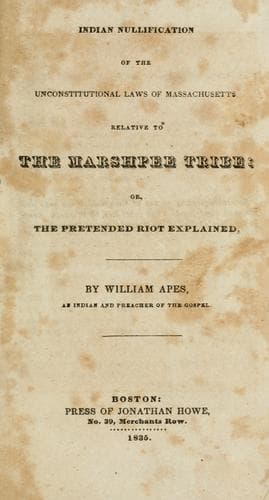
Indian Nullification of the Unconstitutional Laws of Massachusetts Relative to the Marshpee Tribe: Or, the Pretended Riot ExplainedApess, William
History
Indian Nullification of the Unconstitutional Laws of Massachusetts Relative to the Marshpee Tribe: Or, the Pretended Riot Explained
Apess, William
Indians of North America -- Legal status, laws, etc.; Mashpee Indians -- Land tenure; Mashpee Indians -- Legal status, laws, etc.
Mr. Cushing of Dorchester, was not aware that any objections
could be made to the reading of the petition, which he
considered as a matter of course; nor could he see how a
knowledge of the matter could prejudice the House. He presumed
the House would not take upon itself to refuse to hear the
petition of the humblest individual, and he did not fear that
they could not control their minds so far as to be ready to
give a fair hearing to the other side. The intimation that
some document was to come from another source, did not go at
all to show that the petition ought not to be read. Whether
the statement which gentlemen said was to be made, was in aid
or explanation of the petition did not appear, but the subject
was before the House, and ought to receive the attention due
to it.
Mr. Lucas of Plymouth, said (as far as we could hear him) that
the difficulty in the Marshpee tribe had been caused by an
itinerant preacher, who went there and urged them to declare
their independence. They proceeded to extremities, and the
Governor and Council sent a commissioner to examine the
affair, and he made a report to the Council, and until that
was heard, he hoped nothing would be heard from the Indians.
It ought first to come before the House. The petition
originated no doubt, from the itinerant preacher, who had been
pouring into their ears discontent until they had a riot, and
the rioters were prosecuted with the preacher among them,
and he was convicted and imprisoned. Whether any of the
petitioners were among those rioters or not, he did not know.
Mr. Allen of Pembroke, said he had not heard the gentleman
from Plymouth. It was not his wish to prevent the petitioners
being heard at a proper time, but he thought the House ought
to hear the other side, before any course was taken.
Mr. Robinson of Marblehead, hoped that the attempt would not
be persisted in, to withhold from these Indians the common
indulgence of having their petition read.
Mr. Loring of Hingham, understood that this was the same
petition which went before the Governor and Council, [Mr. L.
was misinformed; It is a different petition,] and as it was
very long, it would take up time unnecessarily to read it. He
hoped it would be laid on the table.
Mr. Allen of Worcester, thought those who opposed the reading
were in fact increasing the Importance of the petition by that
course. If the House should refuse to hear it read, a
course he did not remember had ever been adopted toward any
respectful petition, from any quarter, it would become a
subject of much more speculation than if it took the ordinary
course.
Public-domain text, read in full here on John Shaqi.
Reviews
Reviews
No reviews yet
Be the first to share your thoughts on this work.
Join the Discussion
Join the discussion
Sign in to leave a comment or review.
Sign InorCreate an account