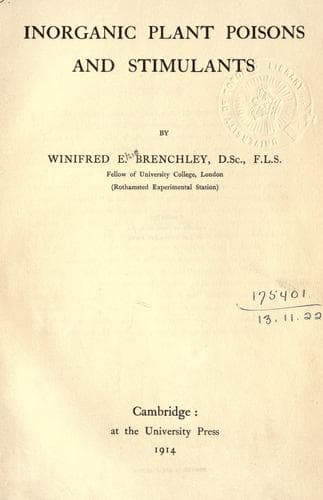
Inorganic Plant Poisons and Stimulants — John Shaqi
Inorganic Plant Poisons and StimulantsBrenchley, Winifred Elsie
Science
Inorganic Plant Poisons and Stimulants
Brenchley, Winifred Elsie
Growth (Plants); Plants -- Effect of poisons on
The occurrence of arsenic as an occasional constituent of plants has
been recognised for many years. Chatin (1845) found that if a plant were
supplied with arsenical compounds at the roots arsenic was absorbed, but
that it was distributed unequally to the various tissues. The greatest
accumulation of the element was in the floral receptacle and the leaves,
while it was scarce in the fruits, seeds, stems, roots and petals. E.
Davy (1859) commented on the presence of arsenic in plants cultivated
for food. He grew peas in pots and watered them for a short time with a
saturated aqueous solution of arsenious acid, the application being then
discontinued. The plants, apparently uninjured by the treatment, flowered
and formed seeds. On analysis arsenic was readily detected in all parts
of the plant, including the seeds. Other analyses revealed the presence
of the element in cabbage plants (from pots) and turnips (from field),
both of which had been manured with superphosphate containing some amount
of arsenic. This absorption of arsenic by the roots of plants was further
established by Phillips (1882).
Various physiological workers have pointed out that this element is
frequently or usually present in animal tissues. Cerný (1901) reached
the general conclusion that minimal traces of arsenic can occur in animal
organisms, but that these play no part in the organism and indeed are not
constant in their occurrence. Bertrand (1902) established its presence in
minute quantities in the thyroid glands of the ox and pig, hair and nails
of the dog, and the feathers of the goose. Gautier and Clausmann (1904)
realised the constant presence of arsenic in human tissues and recognised
that it must inevitably be introduced into the body with the food. This
led them to estimate the arsenic present in various animal and vegetable
foods, some of their results being given in the following table.
_Arsenic per 100 parts fresh substance in µ gr._ (= thousandth part of a
milligram)[8].
Wheat (Victoria--complete grain) ·7
„ (from Franche Comté) ·85
White bread ·71
Whole green cabbage ·2
Outside leaves of cabbage ·0 (absent)
Green haricots ·0 „
Turnip ·36
Potatoes 1·12
[8] 0^{µ gr.}, 1 = 0·0001 mg.
Arsenic was also found in wine and beer and in considerable quantities
in sea water and various kinds of salt. Since it cannot be found in some
things even in the least traces, the authors conclude that it is incorrect
to say that the element is always present or that it is essential to all
living cells.
Public-domain text, read in full here on John Shaqi.
Reviews
Reviews
No reviews yet
Be the first to share your thoughts on this work.
Join the Discussion
Join the discussion
Sign in to leave a comment or review.
Sign InorCreate an account