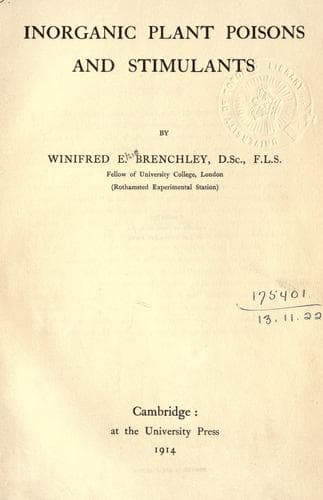
Inorganic Plant Poisons and StimulantsBrenchley, Winifred Elsie
Science
Inorganic Plant Poisons and Stimulants
Brenchley, Winifred Elsie
Growth (Plants); Plants -- Effect of poisons on
S. H. Collins (1902) found that barley is able to absorb relatively
large quantities of arsenic. The plants were grown in pots on soil which
originally contained a certain amount of the substance, and various
combinations of arsenic acid, arsenious acid and superphosphate were
added. Particulars and details are not given by the author, except
that arsenic was detected by Reinsch’s test in the grains from all the
experimental pots, and in one case (not specified) in the upper and lower
halves of the straw and in the threshed ears. The analyses of the soil at
the close of the experiments showed the presence of 7–22 parts arsenious
acid per million.
Wehmer (1911) quotes references to the occurrence of arsenic in _Vitis
vinifera_. The element was detected in the ash of the must and its
presence was attributed to treatment of the plants with arsenical
compounds. In this connection it is interesting to note the observation
of Swain and Harkins (1908), who, while acknowledging the absorption of
arsenic from the soil by many plants, yet indicate that in the case of
those plants which are exposed to smelter smoke the arsenic is deposited
on the vegetation, and is not absorbed by the latter from the soil.
II. EFFECT OF ARSENIC ON THE GROWTH OF HIGHER PLANTS.
1. _Toxic effect._
(_a_) _Toxic action of arsenic compounds in water cultures in the presence
of nutrients._
The poisonous action of arsenic on plants has long been recognised. Chatin
(1845) gave accounts of tissues poisoned by strong arsenical solutions.
Nobbe, Baessler and Will (1884) carried on water culture experiments
with buckwheat, oats, maize and alder, and found that arsenic was a
particularly strong poison for these plants. When small quantities of
arsenious acid (As₂O₃) were added to the food solutions, growth was
measurably hindered by a concentration of 1/1,000,000 As (reckoned as
As). The element only appears in plants in very small quantity and can
never be detected in notable quantities. The aerial organs show the effect
of arsenical poisoning by intense withering, interrupted by periods
of recovery, but eventually followed by death. It was also found that
if plant roots were exposed to the action of arsenical solutions for a
short period, say ten minutes, and then were transferred to normal food
solutions, the action of the poison was delayed, but eventually hindering
of growth or death occurred, according to the strength of the poison used
in the first solution.
Public-domain text, read in full here on John Shaqi.
Reviews
Reviews
No reviews yet
Be the first to share your thoughts on this work.
Join the Discussion
Join the discussion
Sign in to leave a comment or review.
Sign InorCreate an account