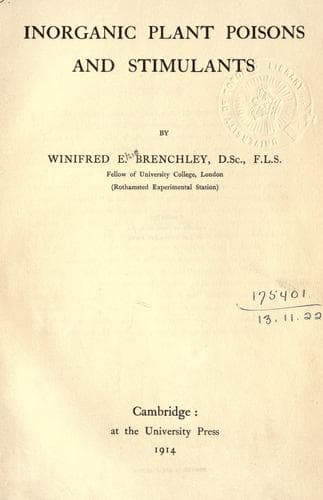
Inorganic Plant Poisons and StimulantsBrenchley, Winifred Elsie
Science
Inorganic Plant Poisons and Stimulants
Brenchley, Winifred Elsie
Growth (Plants); Plants -- Effect of poisons on
Stoklasa (1896, 1898) again found that phanerogamic plants can withstand
arsenic poisoning for some time in the dark or in CO₂-free air, provided
that glucose is given in the food solution. The arsenic poisoning is
at its maximum during carbon assimilation by means of chlorophyll. The
toxic action of arsenious and arsenic acids, especially in phanerogams,
is due to injury to the chlorophyll activity. The destruction of the
living molecule is far more rapid in the chlorophyll apparatus than in
the protoplasm of the plant cell.
Thus it seems that the physiological cause of the toxicity of arsenic is
partly a direct action on the root protoplasm, whereby its osmotic action
is hindered, and partly a detrimental action upon those functions which
are directly concerned with the elaboration processes of nutrition.
2. _Effect of arsenic compounds on germination._
In view of the great toxicity of arsenic to plants in their various stages
of development, one would naturally expect to find a similar action with
regard to the germination of the seeds. Davy (1859) casually mentioned
cases in which watering with arsenical solutions or dipping seeds in
arseniated water prevented germination. Heckel (1875) found that arsenious
acid checks germination and kills the embryo at relatively feeble doses,
·25 gm. to 90 gm. water.[10] Guthrie and Helms (1903–4–5) carried out a
systematic series of experiments to test the effect of arsenic compounds
upon different farm crops. Various amounts of arsenious acid were added
to soil in pot experiments, and the seeds of the several crops were
then sown. With barley, wheat and rye 0·10% arsenious acid had little
or no effect on germination, while an increase in the poison exercised
a retarding action. Maize could withstand 0·40% arsenious acid without
retardation being perceptible. The aftergrowth with the different crops
varied considerably. The wheat plants with 0·10% arsenious acid grew all
right at first, but later on they developed weakly. The toxic action
increased rapidly as the strength of the poison rose in the different
pots. Barley proved even more sensitive than wheat, for even 0·05%
arsenious acid affected the growth adversely. After a time the plants
with 0·05–0·06% recovered and grew strongly, though not so well as the
controls, but those with 0·10% practically died off. Rye behaved in the
reverse way from wheat. The plants with 0·10% were slightly checked at
first but later recovered and made growth quite equal to the check plants.
Growth was stunted with 0·20% arsenious acid, and the plants were killed
with 0·30%, so that rye is far less sensitive than barley. With maize the
growth was slightly affected with 0·05% As₂O₃, and increasingly so with
greater quantities. It was also found that the action of 0·8% As₂O₃ was
strongly adverse to the germination of all plants, and that above this
strength germination was altogether prevented.
Public-domain text, read in full here on John Shaqi.
Reviews
Reviews
No reviews yet
Be the first to share your thoughts on this work.
Elsewhere in the archive
Join the Discussion
Join the discussion
Sign in to leave a comment or review.
Sign InorCreate an account