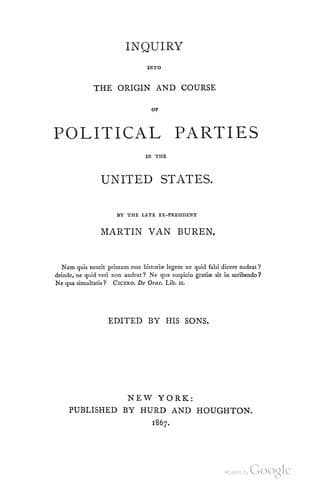
Inquiry Into the Origin and Course of Political Parties in the United StatesVan Buren, Martin
History
Inquiry Into the Origin and Course of Political Parties in the United States
Van Buren, Martin
Political parties -- United States
by those powers only, because the spurious interpolations which have
from time to time been attempted have in no instance been productive of
good.
The Convention was held with closed doors, and the result of its labors
was not known to the public before it was communicated to Congress, nor
the particulars of its proceedings, the votes, resolutions, and
speeches, till many years afterwards. The public mind, and especially
the Anti-Federal portion of it, was impressed by those circumstances,
operating upon long entertained suspicions, with the most unfavorable
anticipations in respect to the character of the instrument that had
been agreed upon. All found it so different from what it was feared by
many that it would be, and so many received it according to its real
merits, that it carried a large preponderance of the public sentiment,
drawn from both parties, to the conclusion that it ought not to be, and
could not with safety be rejected. The reflection of this sentiment was
distinctly seen in the action of Congress. It had given its assent to
the holding of a Convention, without which that body would not have met;
but it had, as we have seen, restricted its action in two most important
points: 1st, that the Convention should limit its action to a revision
of the Articles of Confederation and to suggestions for their
improvement; and, 2d, that its doings should be reported to Congress, to
be submitted to the States, under those Articles which required the
assent of every State to any alteration. The Convention disregarded
both; it sent to Congress a new constitution, regulated its submission
to the States, and decided that the assent of nine of the thirteen
should make it binding upon all. Congress, with its resolutions and
limitations thus set at nought, and without even a protest, did what was
asked of it. Yet the leaders of the Anti-Federal party in the States
determined upon opposition. The course and character of that opposition
indicate that those who embarked in it were conscious of their
approaching defeat.
In the three largest and most strongly Anti-Federal States, in which the
power of that party, when cordially united, was irresistible, the
Constitution was ratified. It was adopted by the required number of
States, and the fate of the Anti-Federal party, as such, was forever
sealed by the result of the contest in which it had unwisely engaged.
CHAPTER II.
Public-domain text, read in full here on John Shaqi.
Reviews
Reviews
No reviews yet
Be the first to share your thoughts on this work.
Elsewhere in the archive
Join the Discussion
Join the discussion
Sign in to leave a comment or review.
Sign InorCreate an account