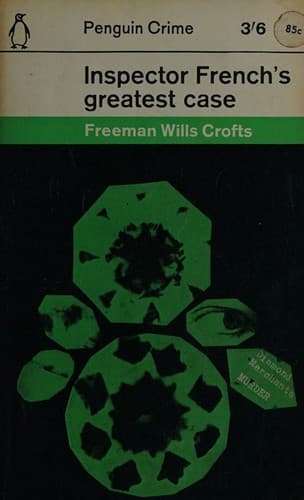
Detective and mystery stories; French, Joseph (Fictitious character) -- Fiction; Police -- Great Britain -- Fiction
“But I’m not trying to take away his character, Emily dear,” he
protested, nettled by this unexpected attack in the rear. “I’m only
saying that he’s the only person we know of who could have got an
impression of the key. If so, it surely follows he was out to rob the
safe.”
“Well, I believe you’re wrong,” the lady affirmed, continuing with a
logic as relentless as his own, “because if he was out to rob the safe,
he wasn’t the sort of man that you described, and if he was the sort of
man that you described, why, then, he wasn’t out to rob the safe. That’s
what I think about it.”
French was a trifle staggered. The difficulty he had recognised from the
beginning, but he had not considered it serious. Now, put to him in the
downright, uncompromising language in which his wife usually clothed her
thoughts, it suddenly seemed to him overwhelming. What she said was
true. There was here a discrepancy. If Gething really bore the character
he was given by all who had known him, he was not a thief.
He ceased his restless movement, and sitting down at the table, he
opened his notebook and began to look up what he had actually learned
about the dead man. And the more he did so, the more he came to believe
that his wife was right. Unless all this cloud of witnesses were
surprisingly mistaken, Gething was innocent.
His mind reverted to the other horn of the dilemma. If Gething were
innocent, who took the impression of the key? It was not obtained from
that in the bank, therefore it was copied from that in Mr. Duke’s
possession. Who had done it?
No one at the office, at least not unless Mr. Duke was greatly mistaken.
And he did not believe the principal could be mistaken on such a point.
The breaking through of his regular custom in a matter of such
importance would almost certainly be noted and remembered. No, French
felt that he might rely on Mr. Duke’s statement so far.
But with regard to his assertion that no one in his house could have
tampered with the key, the Inspector saw that he was on more shaky
ground. In the nature of the case, the diamond merchant would be less
alert in dealing with the members of his own household than with his
business acquaintances. Believing he was surrounded by friends, he would
subconsciously be more ready to assume his precautions adequate. Was Mr.
Duke’s belief that no one would touch the key not the real basis of his
statement that no one had done so?
It seemed to French that here was a possibility that he had overlooked,
and it was in the nature of the man that the moment he reached such a
conclusion he began to consider a way of retrieving his error.
At first he thought of taking Mr. Duke into his confidence and asking
him to assist him in some subterfuge by which he could enter the house.
But presently he saw that it would be better if the old gentleman knew
nothing of his plan, lest he might inadvertently warn a possible
criminal.
Public-domain text, read in full here on John Shaqi.
Reviews
Reviews
No reviews yet
Be the first to share your thoughts on this work.
Join the Discussion
Join the discussion
Sign in to leave a comment or review.
Sign InorCreate an account