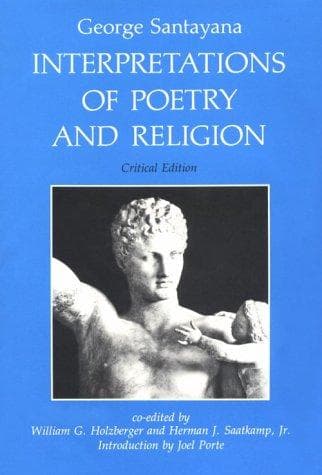
Interpretations of Poetry and ReligionSantayana, George
Religion
Interpretations of Poetry and Religion
Santayana, George
Aesthetics; Literature -- History and criticism; Poetry; Religion
Thus appeared a new scheme for the unification of the natural and the
moral. The harmony which the old religion had failed to establish
in space and in Nature, the new sought to establish in history and
in time. It was hoped that life and experience, sin and redemption,
might manifest that divinity which had fled out of the sea and sky,
and which it seemed sacrilege to identify any longer with the animal
vitality of the universe. Whether the same criticism that disintegrated
mythology and isolated its elements of science and of poetry would
not be fatal to the new combination of the moral and the factual in
the history of man, is hardly a question for us here. Suffice it to
point out the problem and to register the solution which was found
in the ancient world to the analogous problem that presented itself
there. The first impulse of the imagination is always to combine
in the object all the elements which lie together in the mind, to
project them indiscriminately into a single conception of reality,
enriched with as many qualities as there are phases and values in our
experience. But these phases and values have diverse origins and do not
permanently hang together. It becomes after a while impossible to keep
them attached to a single image; they have to be distributed according
to their true order and connections, some objectified into a physical
universe of mechanism and law, others built into a system of rational
objects, into a hierarchy of logical and moral ideas. So the lovely
pantheon of the Greeks yielded in time to analysis and was dissolved
into abstract science and conscious fable. So, too, the body and soul
of later religions may come to be divided, when they render back to
earth what they contain of positive history and to the heaven of man's
indomitable idealism what they contain of aspiration and hope.
IV
THE POETRY OF CHRISTIAN DOGMA
The deathbed of Paganism was surrounded by doctors. Some, the Stoics,
advised a conversion into pantheism (with an allegorical interpretation
of mythology to serve the purposes of edification); others, the
Neo-Platonists, prescribed instead a supernatural philosophy, where the
efficacy of all traditional rites would be justified by incorporation
into a system of universal magic, and the gods would find their
place among the legions of spirits and demons that were to people
the concentric spheres. But these doctors had no knowledge of the
patient's natural constitution; their medicines, prescribed with the
best intentions, were in truth poisons and only hastened the inevitable
end. Nor had the unfortunate doctors the consolation of being heirs.
Parasites that they were, they perished with the patron on whose
substance they had fed, and Christianity, their despised rival, came
into sole possession.
Public-domain text, read in full here on John Shaqi.
Reviews
Reviews
No reviews yet
Be the first to share your thoughts on this work.
Join the Discussion
Join the discussion
Sign in to leave a comment or review.
Sign InorCreate an account