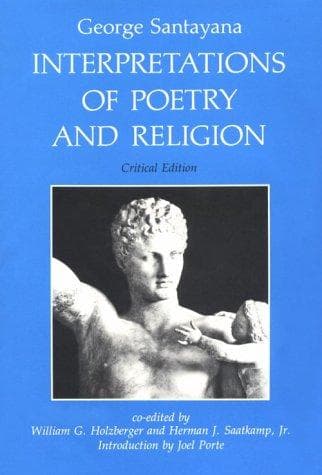
Interpretations of Poetry and ReligionSantayana, George
Religion
Interpretations of Poetry and Religion
Santayana, George
Aesthetics; Literature -- History and criticism; Poetry; Religion
But the trouble was that the bread of Plotinus was a stone. The heart
cannot feed on thin and elaborate abstractions, irrelevant to its
needs and divorced from the natural objects of its interest. Men will
often accept the baldest fictions as truths; but it is impossible
for them to give a human meaning to vacuous conceptions, or to grow
to love the categories of logic, interweaving their image with the
actions and emotions of daily life. Religion must spring from the
people; it must draw its form from tradition and its substance from
the national imagination and conscience. Neo-Platonism drew both
form and substance from a system of abstract thought. Its gods were
still-born, being generated by logical dichotomy. Only in the lower
purlieus of the system, filled in by accepting current superstitions,
was there any contact with something like vital religious forces. But
those minor elements--hopes and fears about another world, fasts and
penances, ecstasies and marvels--had no necessary relation to that
metaphysical system. Such practices could be found in every religion,
in every philosophical sect of the time. The Alexandrian dialectic of
the supernatural accordingly remained a mere schema or skeleton, to be
filled in with the materials of some real religion, if such a religion
should arise. As such a schema the Neo-Platonic system actually passed
over to Christian theology, furnishing the latter with its categories,
its language, and its speculative method. But that dialectic served in
Christianity to give form to a religious substance furnished by Hebrew
and apostolic tradition, a religious substance such as, after the Pagan
religion was discredited, Neo-Platonism necessarily lacked and was
powerless to generate.
Public-domain text, read in full here on John Shaqi.
Reviews
Reviews
No reviews yet
Be the first to share your thoughts on this work.
Elsewhere in the archive
Join the Discussion
Join the discussion
Sign in to leave a comment or review.
Sign InorCreate an account