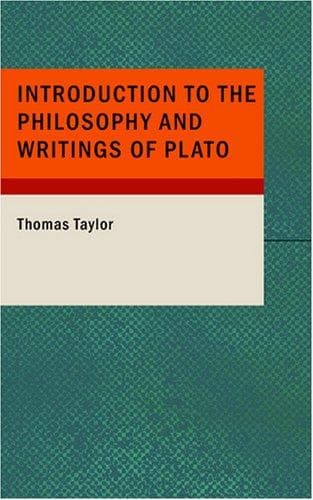
Introduction to the Philosophy and Writings of PlatoTaylor, Thomas
Philosophy
Introduction to the Philosophy and Writings of Plato
Taylor, Thomas
Philosophy; Plato
or when it restrains the wanton tendencies of desire to corporeal delight.
For in all such operations it manifestly subdues the irrational motions,
both gnostic and appetitive, and absolves itself from them, as from
things foreign to its nature. But it is necessary to investigate the
essence of every thing, not from its perversion, but from its energies
according to nature. If therefore reason, when it energizes in us as
reason, restrains the shadowy impressions of the delights of licentious
desire, punishes the precipitate motion of fury, and reproves the senses
as full of deception, asserting that
"We nothing accurate, or see, or hear:"
and if it says this, looking to its internal reasons, none of which it
knows through the body, or through corporeal cognitions, it is evident
that, according to this energy, it removes itself far from the senses,
contrary to the decision of which it becomes separated from those sorrows
and delights.
After this, let us direct our attention to another and a better motion of
our rational soul, when, during the tranquillity of the inferior parts,
by a self-convertive energy, it sees its own essence, the powers which it
contains, the harmonic reasons from which it consists, and the many lives
of which it is the middle boundary, and thus finds itself to be a
rational world, the image of the prior natures, from which it proceeds,
but the paradigm of such as are posterior to itself. To this energy of
the soul, theoretic arithmetic and geometry greatly contribute, for these
remove it from the senses, purify the intellect from the irrational forms
of life with which it is surrounded, and lead it to the incorporeal
perception of ideas. For if these sciences receive the soul replete with
images, and knowing nothing subtile and unattended with material
garrulity; and if they elucidate reasons possessing an irrefragable
necessity of demonstration, and forms full of all certainty and
immateriality, and which by no means call to their aid the inaccuracy of
sensibles, do they not evidently purify our intellectual life from things
which fill us with a privation of intellect, and which impede our
perception of true being?
Public-domain text, read in full here on John Shaqi.
Reviews
Reviews
No reviews yet
Be the first to share your thoughts on this work.
Elsewhere in the archive
Join the Discussion
Join the discussion
Sign in to leave a comment or review.
Sign InorCreate an account