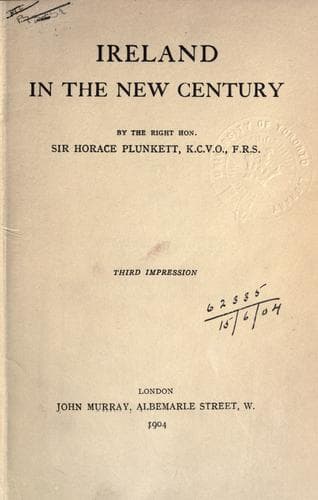
Ireland In The New CenturyPlunkett, Horace Curzon, Sir
History
Ireland In The New Century
Plunkett, Horace Curzon, Sir
Ireland -- Economic conditions; Ireland -- Politics and government -- 1901-1910; Irish question
dictated more by a passionate sympathy for and remembrance of the land
he no longer lives in, than by any right understanding of the interests
of the new country in which he and his children must live.
The only reason why I have examined the assumption that Irishmen display
marked political capacity in the United States is to make it clear that
the political deficiencies they manifest at home are to be attributed
mainly to defects of character, and to a conception of politics for
which modern English government is very slightly responsible. I admit
that English government in the past had no small share in producing the
results we deplore to-day, but the motives and manner of its action
have, it seems to me, been very imperfectly understood.
The fact is that the difficulties of English government in Ireland,
until a complete military conquest had been effected, were of a
peculiarly complex character. Before the English could impose upon
Ireland their own political organisation--and the idea that any other
system could work better among the Irish never entered the English
mind--it was obviously necessary that the very antithesis of that
organisation, the clan system, should be abolished. But there were
military and financial objections to carrying out this policy. Irish
campaigns were very costly, and England was in those days by no means
wealthy. English armies in Ireland, after a short period spent in
desultory warfare with light armed kernes in the fever-stricken Munster
forests, began to melt away. For many generations, therefore, England,
adopting a policy of _divide et impera_, set clan against clan. Later
on, statecraft may be said to have supervened upon military tactics. It
consisted of attempts made by alternate threats and bribes to induce the
chiefs to transform the clan organisation by the acceptance of English
institutions. But any systematic endeavours to complete the
transformation were soon rendered abortive by being coupled with huge
confiscations of land. The policy of converting the members of the clans
into freeholders was subordinated to the policy of planting British
colonists. After this there was no question of fusion of races or
institutions. Plantations on a large scale, self-supporting,
self-protecting, became the policy alike of the soldier and the
statesman.
The inevitable result of these methods was that it was not until a
comparatively late date that a political conception of an Irish nation
first began to emerge out of the congeries of clans. In the State Papers
of the sixteenth century the clans are frequently spoken of as
'nations.' Even as late as the eighteenth century a Gaelic poet, in a
typical lament, thus identifies his country with the fortunes of her
great families:--
The O'Doherty is not holding sway, nor his noble race;
The O'Moores are not strong, that once were brave--
O'Flaherty is not in power, nor his kinsfolk;
And sooth to say, the O'Briens have long since become English.
Public-domain text, read in full here on John Shaqi.
Reviews
Reviews
No reviews yet
Be the first to share your thoughts on this work.
Join the Discussion
Join the discussion
Sign in to leave a comment or review.
Sign InorCreate an account