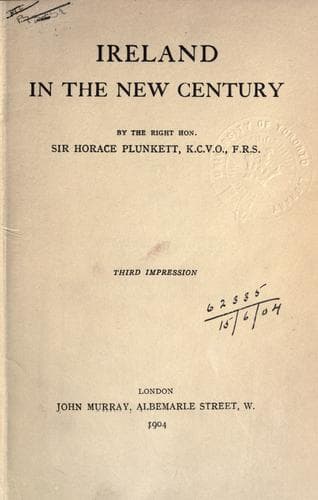
Ireland In The New CenturyPlunkett, Horace Curzon, Sir
History
Ireland In The New Century
Plunkett, Horace Curzon, Sir
Ireland -- Economic conditions; Ireland -- Politics and government -- 1901-1910; Irish question
Of O'Rourke there is no mention--my sharp wounding!
Nor yet of O'Donnell in Erin;
The Geraldines they are without vigour--without a nod,
And the Burkes, the Barrys, the Walshes of the slender ships.[13]
The modern political idea of Irish nationality at length asserted itself
as the result of three main causes. The bond of a common grievance
against the English foe was created by the gradual abandonment of the
policy of setting clan against clan in favour of impartial confiscation
of land from friendly as well as from hostile chiefs. Secondly, when the
English had destroyed the natural leaders, the clan chiefs, and
attempted to proselytise their adherents, the political leadership
largely passed to the Roman Catholic Church, which very naturally
defended the religion common to the members of all the clans, by trying
to unite them against the English enemy. Nationality, in this sense, of
course applied only to Celtic Roman Catholic Ireland. The first real
idea of a United Ireland arose out of the third cause, the religious
grievances of the Protestant dissenters and the commercial grievances of
the Protestant manufacturers and artisans in the eighteenth century, who
suffered under a common disability with the Roman Catholics, and many of
whom came in the end to make common cause with them. But even long after
this conception had become firmly established, the local representative
institutions corresponding to those which formed the political training
of the English in law and administration either did not exist in Ireland
or were altogether in the hands of a small aristocracy, mostly of
non-Irish origin, and wholly non-Catholic. O'Connell's great work in
freeing Roman Catholic Ireland from the domination of the Protestant
oligarchy showed the people the power of combination, but his methods
can hardly be said to have fostered political thought. The efforts in
this direction of men like Gavan Duffy, Davis, and Lucas were
neutralised by the Famine, the after effects of which also did much to
thwart Butt's attempts to develop serious public opinion amongst a
people whose political education had been so long delayed. The prospect
of any early fruition of such efforts vanished with the revolutionary
agrarian propaganda, and independent thinking--so necessary in the
modern democratic state--never replaced the old leader-following habit
which continued until the climax was reached under Parnell.
Public-domain text, read in full here on John Shaqi.
Reviews
Reviews
No reviews yet
Be the first to share your thoughts on this work.
Join the Discussion
Join the discussion
Sign in to leave a comment or review.
Sign InorCreate an account