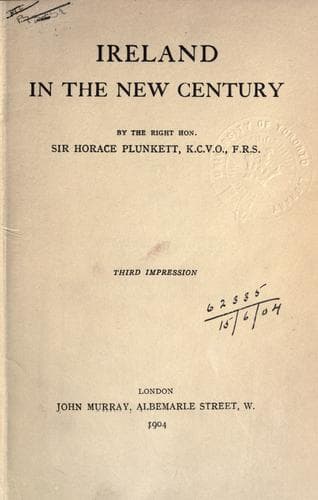
Ireland In The New CenturyPlunkett, Horace Curzon, Sir
History
Ireland In The New Century
Plunkett, Horace Curzon, Sir
Ireland -- Economic conditions; Ireland -- Politics and government -- 1901-1910; Irish question
The leaders of the Nationalist party are, of course, entitled to hold
that, in existing political conditions, any non-political movement
towards national advancement, which in its nature cannot be linked, as
the land question was linked, to the Home Rule movement constitutes an
unwarrantable sacrifice of ends to means. And so holding, they are
further entitled to subject any proposal to elevate popular thought, or
to direct popular activities, to a strict censorship as to its remote as
well as to its immediate effect upon the electorate. I know, too, that
it is held by some thinking Nationalists who take no active part in
politics that the politicians are justified on tactical grounds in this
exclusive pursuit of their political aims, and in the methods by which
they pursue them. They consider the present system of government too
radically wrong to mend, and they can undoubtedly point to agrarian
legislation as evidence of the effectiveness of the means they employ to
gain their end.
This view of things has sunk very deep into the Irish mind. The policy
of 'giving trouble' to the Government is looked upon as the one road to
reform and is believed in so fervently that, except for religion, which
sometimes conflicts with it, there is scarcely any capacity left for
belief in anything else. I am far from denying that the past offers much
justification for the belief that nothing can be gained by Ireland from
England except through violent agitation. Until recently, I admit,
Ireland's opportunity had to wait for England's difficulty. But, as
practised in the present day, I believe this doctrine to be mischievous
and false. For one thing, there is a new England to deal with. The
England which, certainly not in deference to violent agitation,
established the Congested Districts Board, gave Local Government to
Ireland, and accepted the recommendations of the Recess Committee for
far-reaching administrative changes, as well as those of the Land
Conference which involved great financial concessions, is not the
England of fifty years ago, still less the England of the eighteenth
century. Moreover, in riveting the mind of the country on what is to be
obtained from England, this doctrine of 'giving trouble,' the whole
gospel of the agitator, has blinded the Irish people to the many things
which Ireland can do for herself. Whatever may be said of what is called
'agitation' in Ireland as an engine for extorting legislation from the
Imperial Parliament, it is unquestionably bad for the much greater end
of building up Irish character and developing Irish industry and
commerce. 'Agitation,' as Thomas Davis said, 'is one means of redress,
but it leads to much disorganisation, great unhappiness, wounds upon the
soul of a country which sometimes are worse than the thinning of a
people by war.'[14] If Irish politicians had at all realised this truth,
it is difficult to believe that the popular movement of the last quarter
Public-domain text, read in full here on John Shaqi.
Reviews
Reviews
No reviews yet
Be the first to share your thoughts on this work.
Join the Discussion
Join the discussion
Sign in to leave a comment or review.
Sign InorCreate an account