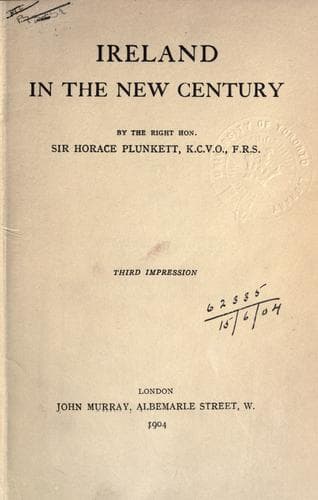
Ireland In The New CenturyPlunkett, Horace Curzon, Sir
History
Ireland In The New Century
Plunkett, Horace Curzon, Sir
Ireland -- Economic conditions; Ireland -- Politics and government -- 1901-1910; Irish question
'unity' they often mistook the wheat for the tares. They will, I feel
sure, come to realise that the passing of the dictatorship, which to
outward appearances left the people as "sheep without a shepherd, when
the snow shuts out the sky," in fact turned the thoughts of Ireland in
some measure away from England into her own bosom, and gave birth there
to the idea of a national life to which the Irish people of all classes,
creeds, and politics could contribute of their best.
I sometimes wonder whether the leaders of the Nationalist party really
understand the full effect of their tactics upon the political character
of the Irish people, and whether their vision is not as much obscured by
a too near, as is the vision of the Unionist leaders by a too distant,
view of the people's life. Everyone who seeks to provide practical
opportunities for Irish intellect to express-itself worthily in active
life--and this, I take it, is part of what the Nationalist leaders wish
to achieve--meets with the same difficulty. The lack of initiative and
shrinking from responsibility, the moral timidity in glaring contrast
with the physical courage--which has its worst manifestation in the
intense dread of public opinion, especially when the unknown terrors of
editorial power lurk behind an unfavourable mention 'on the paper,'
are, no doubt, qualities inherited from a primitive social state in
which the individual was nothing and the community everything. These
defects were intensified in past generations by British statecraft,
which seemed unable to appreciate or use the higher instincts of the
race; they remain to-day a prominent factor in the great human problem
known as the Irish Question--a factor to which, in my belief, may be
attributed the greatest of its difficulties.
It is quite clear that education should have been the remedy for the
defects of character upon which I am forced to dwell so much; and I
cannot absolve any body of Irishmen, possessed of actual or potential
influence, of failure to recognise this truth. But here I am dealing
only with the political leaders, and trying to bring home to them the
responsibility which their power imposes upon them, not only for the
political development but also for the industrial progress of their
followers. They ought to have known that the weakness of character which
renders the task of political leadership in Ireland comparatively easy
is in reality the quicksand of Irish life, and that neither
self-government nor any other institution can be enduringly built upon
it.
Public-domain text, read in full here on John Shaqi.
Reviews
Reviews
No reviews yet
Be the first to share your thoughts on this work.
Join the Discussion
Join the discussion
Sign in to leave a comment or review.
Sign InorCreate an account