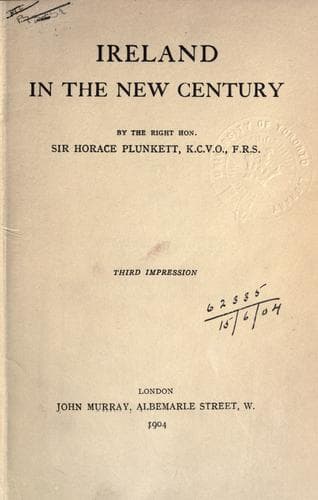
Ireland In The New CenturyPlunkett, Horace Curzon, Sir
History
Ireland In The New Century
Plunkett, Horace Curzon, Sir
Ireland -- Economic conditions; Ireland -- Politics and government -- 1901-1910; Irish question
Tactics form but a part of generalship, and half the success of
generalship lies in making a correct estimate of the opposing forces.
This is as true of political as it is of military operations. Now, of
what do the forces opposed to Home Rule consist? The Unionists, it may
be admitted, are numerically but a small minority of the population of
Ireland--probably not more than one-fourth. But what do they represent?
First, there are the landed gentry. Let us again make a concession for
the sake of argument and accept the view that this class so wantonly
kept itself aloof from the life of the majority of the people that the
Nationalists could not be expected to count them among the elements of a
Home Rule Ireland. I note, in passing, with extreme gratification that
at the recent Land Conference it was declared by the tenants'
representatives that it was desirable, in the interests of Ireland, that
the present owners of land should not be expatriated, and that
inducements should be afforded to selling owners to continue to reside
in the country.
But I may ignore this as I wish here to recall attention to that other
element, which was, as I have already said, the real force which turned
the British democracy against Home Rule--I mean the commercial and
industrial community in Belfast and other hives of industry in the
north-east corner of the country, and in scattered localities elsewhere.
I have already admitted that the political importance of the industrial
element was not appreciated in Irish Unionist circles. No less
remarkable is the way in which it has been ignored by the Nationalists.
The question which the Nationalists had to answer in 1886 and 1893, and
which they have to answer to-day, is this:--In the Ireland of their
conception is the Unionist part of Ulster to be coerced or persuaded to
come under the new regime? To those who adopt the former alternative my
reply is simply that, if England is to do the coercion, the idea is
politically absurd. If we were left to fight it out among ourselves, it
is physically absurd. The task of the Empire in South Africa was light
compared with that which the Nationalists would have on hands. I am
aware that, at the time when we were all talking at concert pitch on the
Irish Question, a good deal was said about dying in the last ditch by
men who at the threat of any real trouble would be found more discreetly
perched upon the first fence. But those who know the temper and fighting
qualities of the working-men opponents of Home Rule in the North are
under no illusion as to the account they would give of themselves if
called upon to defend the cause of Protestantism, liberty, and imperial
unity as they understand it. Let us, however, dismiss this alternative
and give Nationalists credit for the desire to persuade the industrial
North to come in by showing it that it will be to its advantage to join
cordially in the building up of a united Ireland under a separate
legislature.
Public-domain text, read in full here on John Shaqi.
Reviews
Reviews
No reviews yet
Be the first to share your thoughts on this work.
Join the Discussion
Join the discussion
Sign in to leave a comment or review.
Sign InorCreate an account