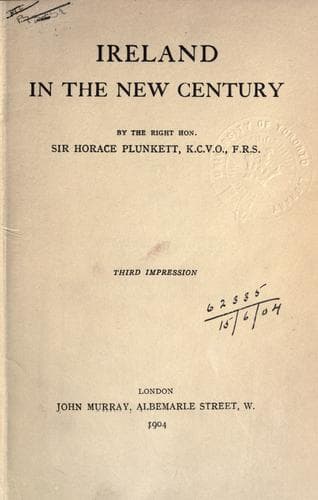
Ireland In The New CenturyPlunkett, Horace Curzon, Sir
History
Ireland In The New Century
Plunkett, Horace Curzon, Sir
Ireland -- Economic conditions; Ireland -- Politics and government -- 1901-1910; Irish question
In this work the very men whose mistaken conception of a united Ireland
I have criticised will, I doubt not, take a leading part. In many
respects, and these not the least important, no one could desire a
better instrument for the achievement of great reforms than the Irish
party. They are far beyond any similar group of English members in
rhetorical skill and quickness of intelligence and decision, qualities
which no doubt belong to the mechanism rather than the soul of politics,
but which the practical worker in public life will not despise. But even
when tried by a higher standard the Irish members need not fear the
judgment of history. They have often, in my opinion, misconceived the
true interests of their country, but they have been faithful to those
interests as they understood them, and have proved themselves notably
superior to sordid personal aims. These gifts and virtues are not
common, but still rarer is it to see such gifts and virtues cursed with
the doom of futility. The influence of the Irish political leaders has
neither advanced the nation's march through the wilderness nor taught
the people how they are to dispense with manna from above when they
reach the Promised Land. With all their brilliancy, they have thrown but
little helpful light on any Irish problem. In this want of political and
economic foresight Irish Nationalist politicians, with some exceptions
whom it would be invidious to name, have fallen lamentably short of what
might be expected of Irish intellect. For the eight years during which I
represented an Irish constituency I always felt that an Irish night in
the House of Commons was one of the strangest and most pathetic of
spectacles. There were the veterans of the Irish party hardened by a
hundred fights, ranging from Venezuela to the Soudan in search of
battlefields, making allies of every kind of foreign potentate, from
President Cleveland to the Mahdi, from Mr. Kruger to the Akhoom of Swat,
but looking with suspicion on every symptom of an independent national
movement in Ireland; masters of the language of hate and scorn, yet
mocked by inevitable and eternal failure; winners of victories that turn
to dust and ashes; devoted to their country, yet, from ignorance of the
real source of its malady, ever widening the gaping wound through which
its life-blood flows. While I recall these scenes, there rises before my
mind the picture vividly drawn by Miss Lawless of their prototypes, the
'Wild Geese,' who carried their swords into foreign service after the
final defeat of the Stuarts:--
War-battered dogs are we,
Fighters in every clime,
Fillers of trench and of grave,
Mockers, bemocked by Time;
War-dogs, hungry and grey,
Gnawing a naked bone,
Fighting in every clime
Every cause but our own.[15]
Public-domain text, read in full here on John Shaqi.
Reviews
Reviews
No reviews yet
Be the first to share your thoughts on this work.
Join the Discussion
Join the discussion
Sign in to leave a comment or review.
Sign InorCreate an account