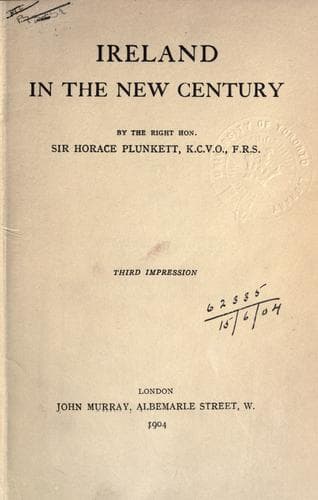
Ireland In The New CenturyPlunkett, Horace Curzon, Sir
History
Ireland In The New Century
Plunkett, Horace Curzon, Sir
Ireland -- Economic conditions; Ireland -- Politics and government -- 1901-1910; Irish question
So far all liberal-minded Protestants, who know what Roman Catholicism
is, will be with me; and for the main purposes of the argument contained
in this chapter it is not necessary to interpret toleration in any wider
sense than that which I have indicated. Many Protestants, among whom I
am one, do, it is true, make a further concession to the claim of our
Roman Catholic fellow-countrymen. We would give them in Ireland
facilities for higher education which we would not give them in England,
and we would advocate liberal endowment by the State to this end. But
this attitude is, I admit, based upon something more than tolerance, and
those who would withhold this concession need not be accused of bigotry
or intolerance for so doing. They may be, and often are, actuated by the
most liberal motives, by a perfectly legitimate conception of
educational principles, or by other considerations which are neither of
a narrow nor sectarian character.
I need hardly say that in criticising religious systems and their
ministers I have not the faintest intention of entering on the
discussion of doctrinal issues. I am, of course, here concerned with
only those aspects of the religious situation which bear directly on
secular life. I am endeavouring, it must be remembered, to arrive at a
comprehensive and accurate appreciation of the chief influences which
mould the character, guide the thought, and, therefore, direct the
action of the Irish people as citizens of this world and of their own
country. From this standpoint let us try to make a dispassionate survey
of Protestantism and Roman Catholicism in Ireland, and see wherein
their votaries fulfil, or fail to fulfil, their mission in advancing our
common civilisation. Let us examine, in a word, not merely the direct
influence which the creed of each of the two sections of Irishmen
produces on the industrial character of its adherents, but also its
indirect effects upon the mutual relations and regard for each other of
Protestants and Roman Catholics.
Protestantism has its stronghold in the great industrial centres of the
North and among the Presbyterian farmers of five or six Ulster counties.
These communities, it is significant to note, have developed the
essentially strenuous qualities which, no doubt, they brought from
England and Scotland. In city life their thrift, industry, and
enterprise, unsurpassed in the United Kingdom, have built up a
world-wide commerce. In rural life they have drawn the largest yield
from relatively infertile soil. Such, in brief, is the achievement of
Ulster Protestantism in the realm of industry. It is a story of which,
when a united Ireland becomes more than a dream, all Irishmen will be
proud.
Public-domain text, read in full here on John Shaqi.
Reviews
Reviews
No reviews yet
Be the first to share your thoughts on this work.
Elsewhere in the archive
Join the Discussion
Join the discussion
Sign in to leave a comment or review.
Sign InorCreate an account