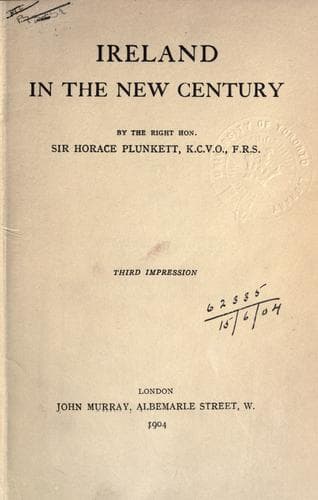
Ireland In The New CenturyPlunkett, Horace Curzon, Sir
History
Ireland In The New Century
Plunkett, Horace Curzon, Sir
Ireland -- Economic conditions; Ireland -- Politics and government -- 1901-1910; Irish question
It is, however, with the religion of the majority of the Irish people
and with its influence upon the industrial character of its adherents
that I am chiefly concerned. Roman Catholicism strikes an outsider as
being in some of its tendencies non-economic, if not actually
anti-economic. These tendencies have, of course, much fuller play when
they act on a people whose education has (through no fault of their own)
been retarded or stunted. The fact is not in dispute, but the difficulty
arises when we come to apportion the blame between ignorance on the part
of the people and a somewhat one-sided religious zeal on the part of
large numbers of their clergy. I do not seek to do so with any precision
here. I am simply adverting to what has appeared to me, in the course of
my experience in Ireland, to be a defect in the industrial character of
Roman Catholics which, however caused, seems to me to have been
intensified by their religion. The reliance of that religion on
authority, its repression of individuality, and its complete shifting of
what I may call the moral centre of gravity to a future existence--to
mention no other characteristics--appear to me calculated, unless
supplemented by other influences, to check the growth of the qualities
of initiative and self-reliance, especially amongst a people whose lack
of education unfits them for resisting the influence of what may present
itself to such minds as a kind of fatalism with resignation as its
paramount virtue.
It is true that one cannot expect of any church or religion, as a
condition of its acceptance, that it will furnish an economic theory;
and it is also true that Roman Catholicism has, at different periods of
history, advantageously affected economic conditions, even if it did not
act from distinctively economic motives--for example, by its direct
influence in the suppression of slavery[17] and its creation of the
mediæval craft guilds. It may, too, be admitted that during the Middle
Ages, when Roman Catholicism was freer than now to manifest its
influence in many directions, owing to its practically unchallenged
supremacy, it favoured, when it did not originate, many forms of sound
economic activity, and was, to say the least, abreast of the time in its
conception of the working of economic causes. But from the time when
the Reformation, by its demand for what we Protestants conceive to be a
simpler Christianity, drove Roman Catholicism back, if I may use the
expression, on its first line of defence, and constrained it to look to
its distinctively spiritual heritage, down to the present day, it has
seemed to stand strangely aloof from any contact with industrial and
economic issues. When we consider that in this period Adam Smith lived
and died, the industrial revolution was effected, and the world-market
opened, it is not surprising that we do not find Roman Catholic
countries in the van of economic progress, or even the Roman Catholic
Public-domain text, read in full here on John Shaqi.
Reviews
Reviews
No reviews yet
Be the first to share your thoughts on this work.
Elsewhere in the archive
Join the Discussion
Join the discussion
Sign in to leave a comment or review.
Sign InorCreate an account