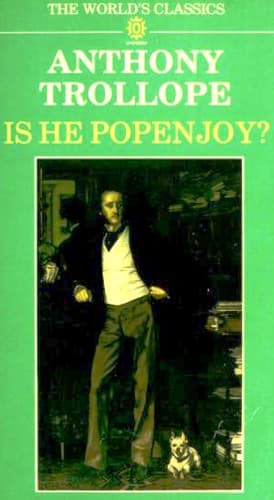
Domestic fiction; Inheritance and succession -- Fiction
"At any rate, do not let other women rule him. By degrees he will learn
to enjoy London society, and so will you. You will spend half the year
at Manor Cross or the deanery, and by degrees both he and you will be
emancipated. For myself, I can conceive nothing more melancholy than
would be his slavery and yours if you were to live throughout the year
with those old women." Then, too, he said something to her of the
satisfaction which she herself would receive from living in London, and
told her that, for her, life itself had hardly as yet been commenced.
She received her lessons with thankfulness and gratitude, but with
something of wonder that he should so openly recommend to her a manner
of life which she had hitherto been taught to regard as worldly.
After that no further hint was given to her that the house in London
might yet be abandoned. When riding back with her husband, she had been
clever enough to speak of the thing as a fixed certainty; and he had
then known that he also must regard it as fixed. "You had better not
say anything more about it," he said one day almost angrily to Lady
Susanna, and then nothing more had been said about it--to him.
There were other causes of confusion,--of terrible confusion,--at Manor
Cross, of confusion so great that from day to day the Marchioness would
declare herself unable to go through the troubles before her. The
workmen were already in the big house preparing for the demolition and
reconstruction of everything as soon as she should be gone; and other
workmen were already demolishing and reconstructing Cross Hall. The
sadness of all this and the weight on the old lady's mind were
increased by the fact that no member of the family had received so much
even as a message from the Marquis himself since it had been decided
that his wishes should not be obeyed. Over and over again the dowager
attempted to give way, and suggested that they should all depart and be
out of sight. It seemed to her that when a marquis is a marquis he
ought to have his own way, though it be never so unreasonable. Was he
not the head of the family? But Lady Sarah was resolved, and carried
her point. Were they all to be pitched down in some strange corner,
where they would be no better than other women, incapable of doing good
or exercising influence, by the wish of one man who had never done any
good anywhere, or used his own influence legitimately? Lady Sarah was
no coward, and Lady Sarah stuck to Cross Hall, though in doing so she
had very much to endure. "I won't go out, my Lady," said Price, "not
till the day when her Ladyship is ready to come in. I can put up with
things, and I'll see as all is done as your Ladyship wishes." Price,
though he was a sporting farmer, and though men were in the habit of
drinking cherry brandy at his house, and though naughty things had been
said about him, had in these days become Lady Sarah's prime minister at
Cross Hall, and was quite prepared in that capacity to carry on war
Public-domain text, read in full here on John Shaqi.
Reviews
Reviews
No reviews yet
Be the first to share your thoughts on this work.
Elsewhere in the archive
Join the Discussion
Join the discussion
Sign in to leave a comment or review.
Sign InorCreate an account