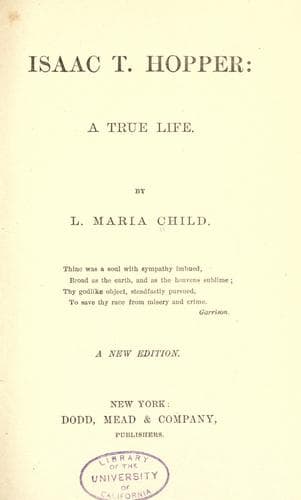
Fugitive slaves -- United States; Hopper, Isaac T. (Isaac Tatem), 1771-1852
A rowdy looking crowd of men and boys followed the fugitive and his
protector, shouting, "Stop thief! Stop thief!" until they came to the
office of a justice of the peace, half a mile from where they started.
The astonished magistrate exclaimed, "Good heavens, Mr. Hopper, what
brings you here this time of the morning, in such a trim, and with such
a rabble at your heels!" When the circumstances were briefly explained,
he laughed heartily, and said, "I don't think they would have treated
you so roughly, if they had known who you were." He was informed that
Levin was a slave in Maryland, but had been living in Delaware with a
man who bought him, and had thus become legally free. Measures were
taken to protect him from further aggression, and he was never after
molested.
Friend Hopper went home to a late breakfast; and when he attempted to
rise from the table, he was seized with violent pains in the back, in
consequence of his fall. He never after entirely recovered from the
effects of it.
ETIENNE LAMAIRE.
This man was a slave to a Frenchman of the same name, in the Island of
Guadaloupe. In consideration of faithful services, his master gave him
his freedom, and he opened a barber's shop on his own account. Some time
after, he was appointed an officer in the French army, against Victor
Hughes. He had command of a fort, and remained in the army until the
close of the war. After that period, there were symptoms of insurrection
among the colored people, because the French government revoked the
decree abolishing slavery in their West India Islands. Etienne was a man
of talent, and had acquired considerable influence, particularly among
people of his own color. He exerted this influence on the side of mercy,
and was the means of saving the lives of several white people who had
rendered themselves obnoxious by their efforts to restore slavery.
Affairs were so unsettled in Guadaloupe, that Etienne determined to seek
refuge in the United States; and an old friend of his master procured a
passport for him. A man by the name of Anslong, then at Guadaloupe, had
two slaves, whom he was about to send to the care of Dennis Cottineau,
of Philadelphia, with directions to place them on a farm he owned, near
Princeton, New-Jersey. When it was proposed that Etienne should take
passage in the same vessel, Anslong manifested much interest in his
behalf. He promised that he should have his passage free, for services
that he might render on board; and he took charge of his passport,
saying that he would give it to the captain for safe keeping.
Public-domain text, read in full here on John Shaqi.
Reviews
Reviews
No reviews yet
Be the first to share your thoughts on this work.
Join the Discussion
Join the discussion
Sign in to leave a comment or review.
Sign InorCreate an account