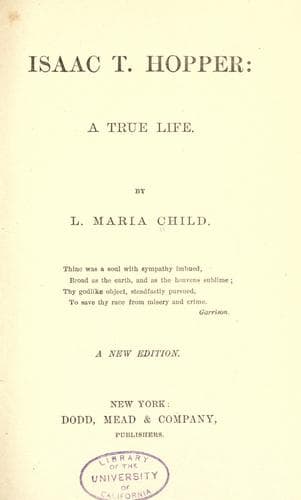
Fugitive slaves -- United States; Hopper, Isaac T. (Isaac Tatem), 1771-1852
When the vessel arrived at Philadelphia, in March, 1803, Etienne was
astonished to find that Anslong had paid his passage, and claimed him
as his slave. Dennis Cottineau showed the receipts for the passage
money, and written directions to forward the _three_ slaves to
New-Jersey. In this dilemma, he asked counsel of a colored man, whom he
had formerly known in Guadaloupe; and he immediately conducted him to
Isaac T. Hopper. He related the particulars of his case very
circumstantially, and the two colored men, who were really the slaves of
Anslong, confirmed his statement. When Friend Hopper had cautiously
examined them, and cross-examined them, he became perfectly satisfied
that Etienne was free. He advised him not to leave the city, and told
him to let him know in case Dennis Cottineau attempted to compel him to
do so. He accordingly waited upon that gentleman and told him he had
resolved not to submit to his orders to go to New-Jersey. Whereupon
Cottineau took possession of his trunk, containing his papers and
clothing, and caused him to be committed to prison.
A writ of _habeas corpus_ was procured, and the case was brought before
Judge Inskeep, of the Court of Common Pleas. It was found to be involved
in considerable difficulty. For while several witnesses swore that they
knew Etienne in Guadaloupe, as a free man, in business for himself,
others testified that they had known him as the slave of Anslong. It was
finally referred to the Supreme Court, and Etienne was detained in
prison several months to await his trial. Eminent counsel were employed
on both sides; Jared Ingersoll for the claimant, and Joseph Hopkinson
for the defendant. A certificate was produced from the municipality of
Guadaloupe, showing that Etienne had been an officer in the French army
for several years, and had filled the station in a manner to command
respect. The National Decree abolishing slavery in that Island was also
read; but Mr. Ingersoll contended that when the decree was revoked,
Etienne again became a slave. In his charge, Judge Shippen said that the
evidence for and against freedom was about equally balanced; and in that
case, it was always a duty to decide in favor of liberty. The jury
accordingly brought in a unanimous verdict that Etienne was free. The
court ordered him to refund the twenty dollars, which Anslong had paid
for his passage; and he was discharged.
Public-domain text, read in full here on John Shaqi.
Reviews
Reviews
No reviews yet
Be the first to share your thoughts on this work.
Join the Discussion
Join the discussion
Sign in to leave a comment or review.
Sign InorCreate an account