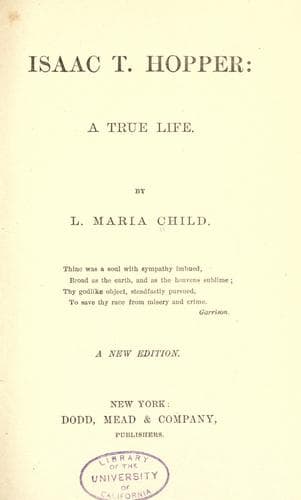
Fugitive slaves -- United States; Hopper, Isaac T. (Isaac Tatem), 1771-1852
He was a dark mulatto, tall, well-proportioned, and stylish-looking. His
handsome countenance had a remarkably bright, frank expression, and
there was a degree of courteous dignity in his manner, probably acquired
by companionship with military officers. But he belonged to a caste
which society has forbidden to develop the faculties bestowed by nature.
Such a man might have performed some higher use than cutting hair, if he
had lived in a wisely organized state of society. However, he made the
best of such advantages as he had. He opened a barber's shop in
Philadelphia, and attracted many of the most highly respectable citizens
by his perfect politeness and punctuality. The colored people had
various benevolent societies in that city, for the relief of the poor,
the sick, and the aged, of their own complexion. Etienne Lamaire was
appointed treasurer of several of these societies, and discharged his
trust with scrupulous integrity.
Isaac T. Hopper had been very active and vigilant in assisting him to
regain his freedom; and afterward, when he became involved in some
difficulty on account of stolen goods left on his premises without his
knowledge, he readily became bail for him. His confidence had not been
misplaced; for when the affair had been fully investigated, the recorder
declared that Mr. Lamaire had acted like an honest and prudent man,
throughout the whole transaction.
His gratitude to Friend Hopper was unbounded, and he missed no
opportunity to manifest it. To the day of his death, some fourteen or
fifteen years ago, he never would charge a cent for shaving, or cutting
the hair of any of the family, children, or grand-children; and on New
Year's day, he frequently sent a box of figs, or raisins, or bon-bons,
in token of grateful remembrance.
SAMUEL JOHNSON.
Samuel Johnson was a free colored man in the state of Delaware. He
married a woman who was slave to George Black. They had several
children, and when they became old enough to be of some value as
property, their parents were continually anxious lest Mr. Black should
sell them to some Georgia speculator, to relieve himself from pecuniary
embarrassment; an expedient which was very often resorted to under such
circumstances. When Johnson visited his wife, they often talked together
on the subject; and at last they concluded to escape to a free state.
They went to Philadelphia and hired a small house. He sawed wood, and
she took in washing. Being industrious and frugal, they managed to live
very comfortably, except the continual dread of being discovered.
Public-domain text, read in full here on John Shaqi.
Reviews
Reviews
No reviews yet
Be the first to share your thoughts on this work.
Join the Discussion
Join the discussion
Sign in to leave a comment or review.
Sign InorCreate an account