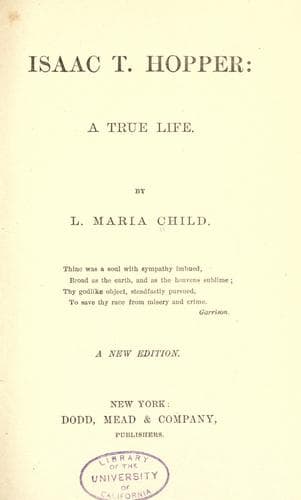
Fugitive slaves -- United States; Hopper, Isaac T. (Isaac Tatem), 1771-1852
Friend Hopper replied, "If the man were as happy with thee as thou hast
represented, he will doubtless return voluntarily, and my assistance
will be quite unnecessary. I do not justify falsehood and deception; but
I am by no means surprised at them in one who has always been a slave,
and had before him the example of slaveholders. Why thou shouldst accuse
him of ingratitude, is more than I can comprehend. It seems to me that
he owes thee nothing. On the contrary, I should suppose that thou wert
indebted to him; for I understand that he has served thee more than
thirty years without wages. So far from helping thee to hunt the poor
fugitives, I will, with all my heart, do my utmost to keep them out of
thy grasp."
"Have you seen my man?" inquired the slaveholder.
"He came to me when he left his own house in Green's Court," replied
Friend Hopper; "and I gave him such advice on that occasion, as I
thought proper. Thou art the first slaveholder I ever met with bearing
my name. Perhaps thou hast assumed it, as a means of gaining the
confidence of colored people, to aid thee in recapturing the objects of
thy avarice."
The Colonel replied that it was really his name, and departed without
having gained much satisfaction from the interview. He remained in
Philadelphia a week or ten days, where he was seized with _mania a
potu_. He was carried home in a straight jacket, where he soon after
died.
A few months after these transactions, the slave called to see Friend
Hopper. He laughed till he could hardly stand, while he described the
method he had taken to elude his old master, and the comical scene that
followed with him and the constable. "I knew his weak side," said he. "I
knew where to touch him."
Friend Hopper inquired whether he was not aware that it was wrong to
tell falsehoods, and to get men drunk.
"I suppose it _was_ wrong," he replied. "But liberty is sweet; and none
of us know what we would do to secure it, till we are tried."
He afterward returned to Philadelphia, where he supported his family
comfortably, and remained unmolested.
JAMES DAVIS.
In 1795, James escaped from bondage in Maryland, and went to
Philadelphia, where he soon after married. He remained undisturbed for
ten years, during which time he supported himself and family comfortably
by sawing wood. But one day, in the year 1805, his master called to see
him, accompanied by two other men, who were city constables. He appeared
to be very friendly, asked James how he was getting along, and said he
was glad to see him doing so well. At last, he remarked, "As you left
my service without leave, I think you ought to make me some
compensation for your time. Autumn is now coming on, and as that is
always a busy season for wood-sawyers, perhaps you can make me a small
payment at that time."
Public-domain text, read in full here on John Shaqi.
Reviews
Reviews
No reviews yet
Be the first to share your thoughts on this work.
Elsewhere in the archive
Join the Discussion
Join the discussion
Sign in to leave a comment or review.
Sign InorCreate an account