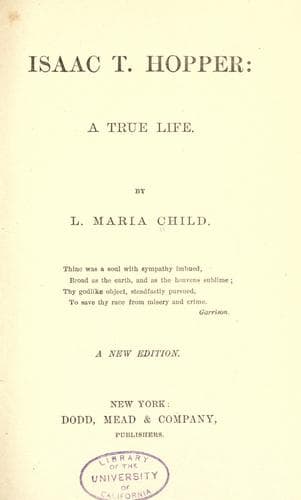
Fugitive slaves -- United States; Hopper, Isaac T. (Isaac Tatem), 1771-1852
A very light mulatto girl, named Fanny, was slave to the widow of John
Sears, in Maryland. When about twenty-four years old, she escaped to
Philadelphia, and lived in the family of Isaac W. Morris, where she was
known by the assumed name of Mary Holliday. She was honest, prudent, and
industrious, and the family became much attached to her. She had not
been there many months when her mistress obtained tidings of her, and
went to Philadelphia, accompanied by a man named Dutton. She was
arrested on the seventh of June, 1805, and taken before Matthew Lawler,
who was then mayor. Isaac W. Morris immediately waited on Isaac T.
Hopper to inform him of the circumstance, and they proceeded together to
the mayor's office.
Dutton, being examined as a witness, testified that he knew a mulatto
named Fanny, who belonged to Mrs. Sears, and he believed the woman
present, called Mary Holliday, was that person. Mary denied that she was
the slave of the claimant, or that her name was Fanny; but her agitation
was very evident, though she tried hard to conceal it.
Friend Hopper remarked to the mayor, "This case requires testimony as
strong as if the woman were on trial for her life, which is of less
value than liberty. I object to the testimony as insufficient; for the
witness cannot say positively that he _knows_ she is the same person,
but only that he _believes_ so. Wouldst thou consider such evidence
satisfactory in the case of a white person?"
The mayor who was not friendly to colored people, replied, "I should
not; but I consider it sufficient in such cases as these."
"How dark must the complexion be, to justify thee in receiving such
uncertain evidence?" inquired Friend Hopper.
The mayor pointed to the prisoner and said, "As dark as that woman."
"What wouldst thou think of such testimony in case of thy own daughter?"
rejoined Friend Hopper. "There is very little difference between her
complexion and that of the woman now standing before thee."
He made no reply, but over-ruled the objection to the evidence. He
consented, however, to postpone the case three days, to give time to
procure testimony in her favor.
Isaac W. Morris soon after called upon Friend Hopper and said, "Mary has
acknowledged to us that her name is Fanny, and that she belongs to Mrs.
Sears. My family are all very much attached to her, and they cannot bear
the thought of her being carried away into slavery. I will advance three
hundred dollars, if thou wilt obtain her freedom."
Public-domain text, read in full here on John Shaqi.
Reviews
Reviews
No reviews yet
Be the first to share your thoughts on this work.
Elsewhere in the archive
Join the Discussion
Join the discussion
Sign in to leave a comment or review.
Sign InorCreate an account