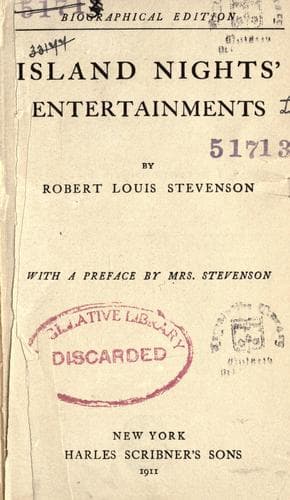
Island Nights' EntertainmentsStevenson, Robert Louis
General
Island Nights' Entertainments
Stevenson, Robert Louis
Islands of the Pacific -- Fiction; Short stories
Well, so I did. I used to be bothered about my balances, but I reasoned
it out this way: We all have queerish balances; and the natives all
know it, and water their copra in a proportion so that it’s fair all
round; but the truth is, it did use to bother me, and, though I did
well in Falesá, I was half glad when the firm moved me on to another
station, where I was under no kind of a pledge and could look my
balances in the face.
As for the old lady, you know her as well as I do. She’s only the one
fault. If you don’t keep your eye lifting she would give away the roof
off the station. Well, it seems it’s natural in Kanakas. She’s turned a
powerful big woman now, and could throw a London bobby over her
shoulder. But that’s natural in Kanakas too, and there’s no manner of
doubt that she’s an A 1 wife.
Mr. Tarleton’s gone home, his trick being over. He was the best
missionary I ever struck, and now, it seems, he’s parsonising down
Somerset way. Well, that’s best for him; he’ll have no Kanakas there to
get luny over.
My public-house? Not a bit of it, nor ever likely. I’m stuck here, I
fancy. I don’t like to leave the kids, you see: and—there’s no use
talking—they’re better here than what they would be in a white man’s
country, though Ben took the eldest up to Auckland, where he’s being
schooled with the best. But what bothers me is the girls. They’re only
half-castes, of course; I know that as well as you do, and there’s
nobody thinks less of half-castes than I do; but they’re mine, and
about all I’ve got. I can’t reconcile my mind to their taking up with
Kanakas, and I’d like to know where I’m to find the whites?
THE BOTTLE IMP.
Note.—Any student of that very unliterary product, the English drama of
the early part of the century, will here recognise the name and the
root idea of a piece once rendered popular by the redoubtable O. Smith.
The root idea is there and identical, and yet I hope I have made it a
new thing. And the fact that the tale has been designed and written for
a Polynesian audience may lend it some extraneous interest nearer
home.—R. L. S.
There was a man of the Island of Hawaii, whom I shall call Keawe; for
the truth is, he still lives, and his name must be kept secret; but the
place of his birth was not far from Honaunau, where the bones of Keawe
the Great lie hidden in a cave. This man was poor, brave, and active;
he could read and write like a schoolmaster; he was a first-rate
mariner besides, sailed for some time in the island steamers, and
steered a whaleboat on the Hamakua coast. At length it came in Keawe’s
mind to have a sight of the great world and foreign cities, and he
shipped on a vessel bound to San Francisco.
Public-domain text, read in full here on John Shaqi.
Reviews
Reviews
No reviews yet
Be the first to share your thoughts on this work.
Elsewhere in the archive
Join the Discussion
Join the discussion
Sign in to leave a comment or review.
Sign InorCreate an account