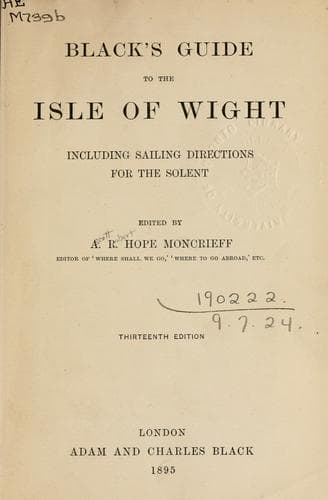
Isle of WightMoncrieff, A. R. Hope (Ascott Robert Hope)
History
Isle of Wight
Moncrieff, A. R. Hope (Ascott Robert Hope)
Isle of Wight (England) -- Description and travel
Why tell such tales? it may be asked by those who remember how Tennyson
looked forward with horror to his weaknesses being exposed to the public
eye. Because a great man’s life cannot be kept private; and no picture
of him is of value with all the warts painted out. Those who knew the
poet agree that he had rough ways and some coarse tastes singularly in
contrast with the “saccharinity ineffable” which certain tart critics of
another generation distaste in his verse. Those who knew him best are
most emphatic as to the essential nobility of character that for them
veiled all short-comings. The main interest of his life, as a human
document, is that a man who had such faults should by force of genius
have been able to transmute them into lessons of purity, courtesy, and
charity, that will shine all the brighter as rays of a soul not
“faultily faultless, icily regular, splendidly null.” And there will be
an end to all fruitful biography, if the “good taste” so much admired by
this generation is to overlay truth. Who would read the memoirs of a
former age if they represented Samuel Johnson as a model of polite
elegance, Goldsmith of practical common sense, and Wilkes of untarnished
public spirit. So, without wanting in honest admiration for the greatest
poet of my time, I protest against the conspiracy of silence by which he
has been raised to a House of Lords among the immortals, his old cloak
and hat forgotten in ermine and coronet, and his strong tobacco and
full-bodied port glorified as nectar and ambrosia.
But if there were some to find the poet no more than a man, and others
to regret that he let his world-wide fame be obfuscated in such a title
as is sold to a prosperous brewer or money-broker, all tongues are at
one in praise of the gentle lady still remembered as a devoted wife, as
a friendly neighbour, and as an open-handed mistress of the manor. To
William Allingham, Tennyson reported the character given of them by an
ex-servant: “She is an angel--but he, why he’s only a public writer!”
Many a tear was shed when, after long suffering, Lady Tennyson came to
rest in the churchyard of Freshwater, her husband lying apart among our
renowned dead. Within the Church are memorials of their second son
Lionel, whose promising career was cut short by fever in the far East,
and he found a hasty grave on a sun-blighted island of the Red Sea.
Public-domain text, read in full here on John Shaqi.
Reviews
Reviews
No reviews yet
Be the first to share your thoughts on this work.
Join the Discussion
Join the discussion
Sign in to leave a comment or review.
Sign InorCreate an account