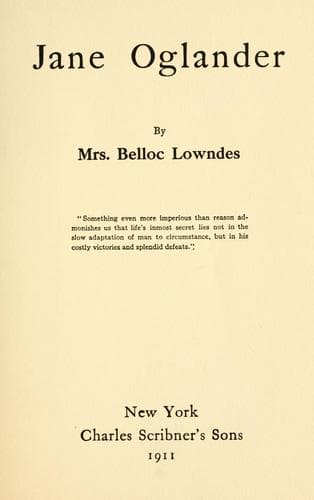
Country homes -- Fiction; England -- Social life and customs -- Fiction; Man-woman relationships -- Fiction
And he saw with a queer feeling of mingled pleasure and jealous pain
that she did indeed look glad; also that there had in very truth come a
change over her face. Jane Oglander possessed that which is not always
the attribute of beauty, a great and varying charm of expression, but
Wantele had never seen her eyes filled, as they were to-day, with
gladness.
"I nearly came by the later train," she said. "For I had to see a child
off to the country, to a convalescent home, and its train went at the
same time as mine. But I found a kind, understanding porter, and so it
was all right. Working people are so good to one another, Dick. The
porter wouldn't take the sixpence I offered him for looking after the
little boy----" And in her voice there was still that under-current of
joyousness which was so new, and, to Wantele, so unexpected.
Jane Oglander looked as if the six last years had been blotted out,--as
if she were again a happy girl, pathetically, confidently ignorant of
the ugly realities of life.
They walked out of the station together, and with a simultaneous
movement they turned into the field path which formed a short cut to
Rede Place. Soon they fell into the easy, desultory talk of those who
have many interests and occupations in common. The young man had saved
up many little things to tell her--things that he thought would amuse
Jane, things about which he wished to consult her.
And as they walked side by side, Wantele kept reminding himself, with
deep, voiceless melancholy, that this was the last time--the last time
that Jane Oglander would be what she had been for so long, his chief
friend and favourite companion. Lingard--happy Lingard had been right.
More fortunate than Wantele, he had found that hour most men seek and
never find, the hour wherein a man may be happy all his life.
They were now close to the house, and as yet neither had spoken the name
of Jane's lover. "Shall we go in by the Garden Room?" asked Wantele.
Now had come the moment when he must tell her of Athena's and Lingard's
absence; also, when he must, if he could bring himself to do so, wish
her joy.
"You'll have to put up with me for a bit longer, Jane. Athena has taken
General Lingard to lunch at the Paches'. Of course you heard of the
accident?"
"Yes," she said. "Poor Patty!" And then, with a rather quizzical
expression in her kind eyes, "It's odd, isn't it, Dick, that Hew should
be related to the Paches----"
With no answering smile on his face, he exclaimed, "Amazing!"
He put the key in the lock, and turning it pushed open the glass door.
Then he fell back so that she should pass in before him.
"Jane," he muttered hoarsely, "Jane, you know what I would say to
you--how truly I wish you joy----"
She looked up, and then quickly cast down her eyes. Wantele had grown
very pale, across his plain face was written suffering and renunciation.
"I knew," she said in a low voice, "I knew that you would wish me joy."
Public-domain text, read in full here on John Shaqi.
Reviews
Reviews
No reviews yet
Be the first to share your thoughts on this work.
Join the Discussion
Join the discussion
Sign in to leave a comment or review.
Sign InorCreate an account