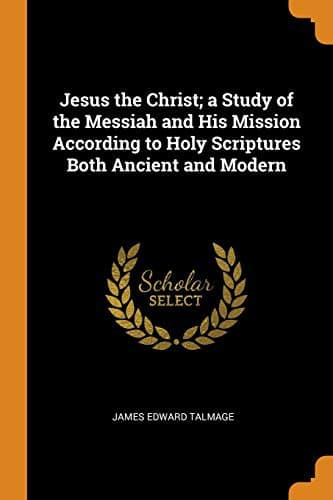
Jesus the Christ: A Study of the Messiah and His Mission According to Holy; Scriptures Both Ancient and ModernTalmage, James E. (James Edward)
Religion
Jesus the Christ: A Study of the Messiah and His Mission According to Holy; Scriptures Both Ancient and Modern
Talmage, James E. (James Edward)
Christian biography -- Palestine; Jesus Christ -- Biography; Jesus Christ -- Mormon interpretations
The occasion of the Savior's advent was preappointed; and the time
thereof was specifically revealed through authorized prophets on each of
the hemispheres. The long history of the Israelitish nation had unfolded
a succession of events that found a relative culmination in the earthly
mission of the Messiah. That we may the better comprehend the true
significance of the Lord's life and ministry while in the flesh, some
consideration should be given to the political, social, and religious
condition of the people amongst whom He appeared and with whom He lived
and died. Such consideration involves at least a brief review of the
antecedent history of the Hebrew nation. The posterity of Abraham
through Isaac and Jacob had early come to be known by the title in which
they took undying pride and found inspiring promise, Israelites, or the
children of Israel.[148] Collectively they were so designated throughout
the dark days of their bondage in Egypt;[149] so during the four decades
of the exodus and the return to the land of promise,[150] and on through
the period of their prosperity as a mighty people under the
administration of the judges, and as a united monarchy during the
successive reigns of Saul, David, and Solomon.[151]
Immediately following the death of Solomon, about 975 B.C. according to
the most generally accepted chronology, the nation was disrupted by
revolt. The tribe of Judah, part of the tribe of Benjamin, and small
remnants of a few other tribes remained true to the royal succession,
and accepted Rehoboam, son of Solomon, as their king; while the rest,
usually spoken of as the Ten Tribes, broke their allegiance to the house
of David, and made Jeroboam, an Ephraimite, their king. The Ten Tribes
retained the title Kingdom of Israel though also known as Ephraim.[152]
Rehoboam and his adherents were distinctively called the Kingdom of
Judah. For about two hundred and fifty years the two kingdoms maintained
their separate autonomy; then, about 722 or 721 B.C., the independent
status of the Kingdom of Israel was destroyed, and the captive people
were transported to Assyria by Shalmanezer and others. Subsequently they
disappeared so completely as to be called the Lost Tribes. The Kingdom
of Judah was recognized as a nation for about one hundred and thirty
years longer; then, about 588 B.C., it was brought into subjection by
Nebuchadnezzar, through whom the Babylonian captivity was inaugurated.
For three score years and ten Judah was kept in exile and virtual
bondage, in consequence of their transgression as had been predicted
through Jeremiah.[153] Then the Lord softened the hearts of their
captors, and their restoration was begun under the decree of Cyrus the
Persian, who had subdued the Babylonian kingdom. The Hebrew people were
permitted to return to Judea, and to enter upon the work of rebuilding
the temple at Jerusalem.[154]
Public-domain text, read in full here on John Shaqi.
Reviews
Reviews
No reviews yet
Be the first to share your thoughts on this work.
Join the Discussion
Join the discussion
Sign in to leave a comment or review.
Sign InorCreate an account