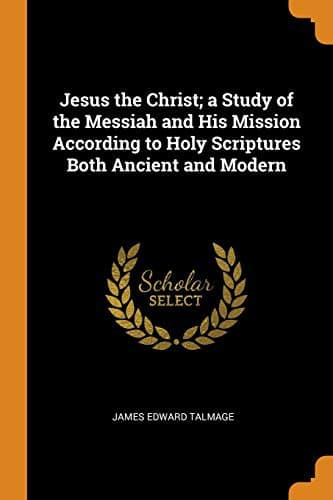
Jesus the Christ: A Study of the Messiah and His Mission According to Holy; Scriptures Both Ancient and ModernTalmage, James E. (James Edward)
Religion
Jesus the Christ: A Study of the Messiah and His Mission According to Holy; Scriptures Both Ancient and Modern
Talmage, James E. (James Edward)
Christian biography -- Palestine; Jesus Christ -- Biography; Jesus Christ -- Mormon interpretations
In the New Testament the Pharisees are often mentioned as in opposition
to the Sadducees; and such were the relations of the two parties that it
becomes a simpler matter to contrast one with the other than to consider
each separately. The Sadducees came into existence as a reactionary
organization during the second century B.C., in connection with an
insurgent movement against the Maccabean party. Their platform was that
of opposition to the ever-increasing mass of traditional lore, with
which the law was not merely being fenced or hedged about for safety,
but under which it was being buried. The Sadducees stood for the
sanctity of the law as written and preserved, while they rejected the
whole mass of rabbinical precept both as orally transmitted and as
collated and codified in the records of the scribes. The Pharisees
formed the more popular party; the Sadducees figured as the aristocratic
minority. At the time of Christ's birth the Pharisees existed as an
organized body numbering over six thousand men, with Jewish women very
generally on their side in sympathy and effort;[174] while the Sadducees
were so small a faction and of such limited power that, when they were
placed in official positions, they generally followed the policy of the
Pharisees as a matter of incumbent expediency. The Pharisees were the
Puritans of the time, unflinching in their demand for compliance with
the traditional rules as well as the original law of Moses. In this
connection note Paul's confession of faith and practise when arraigned
before Agrippa--"That after the most straitest sect of our religion I
lived a Pharisee."[175] The Sadducees prided themselves on strict
compliance with the law, as they construed it, irrespective of all
scribes or rabbis. The Sadducees stood for the temple and its prescribed
ordinances, the Pharisees for the synagog and its rabbinical teachings.
It is difficult to decide which were the more technical if we judge each
party by the standard of its own profession. By way of illustration: the
Sadducees held to the literal and full exaction of the Mosaic
penalty--an eye for an eye and a tooth for a tooth[176]--while the
Pharisees contended on the authority of rabbinical dictum, that the
wording was figurative, and that therefore the penalty could be met by a
fine in money or goods.
Pharisees and Sadducees differed on many important if not fundamental
matters of belief and practise, including the preexistence of spirits,
the reality of a future state involving reward and punishment, the
necessity for individual self-denial, the immortality of the soul, and
the resurrection from the dead; in each of which the Pharisees stood for
the affirmative while the Sadducees denied.[177] Josephus avers--the
doctrine of the Sadducees is that the soul and body perish together; the
law is all that they are concerned to observe.[178] They were "a
skeptical school of aristocratic traditionalists; adhering only to the
Mosaic law."[179]
Public-domain text, read in full here on John Shaqi.
Reviews
Reviews
No reviews yet
Be the first to share your thoughts on this work.
Elsewhere in the archive
Join the Discussion
Join the discussion
Sign in to leave a comment or review.
Sign InorCreate an account