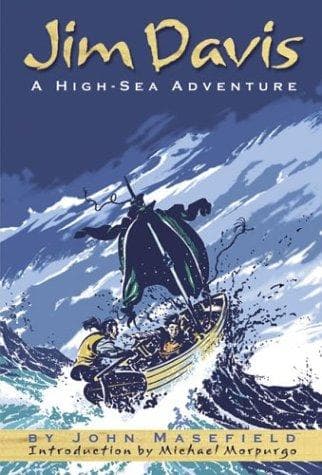
"Fire!" said the voice; and a volley ripped up the sea all round us,
knocking off splinters from the plank and flattening out against the
transom.
"Keep down, Jim; you're all right," said Marah. "We will be out of
range in another minute."
Bang! came a second volley, and then single guns cracked and banged at
intervals as we drew away.
For the next half-hour we were just within extreme range of the
carbines and musketoons. During that half-hour we were slowly slipping
by the long two miles of Slapton sands. We could not go fast, for our
only sail was a coat, and, though the wind was pretty fresh, the set
of the tide was against us. So for half an hour we crouched below that
rowboat's gunwale, just peeping up now and then to see the white line
of the breakers on the sand, and beyond that the black outlines of the
horsemen, who slowly followed us, firing steadily, but with no very
clear view of what they fired at. I thought that the two miles would
never end. Sometimes the guns would stop for a minute, and I would
think, "Ah! now we are out of range," or, "Now they have given us up."
And then, in another second, another volley would rattle at us, and
perhaps a bullet would go whining overhead, or a heavy chewed slug
would come "plob" into the boat's side within six inches of me.
Marah didn't seem to mind their firing. He was too pleased at having
led the preventives away from the main body of the night-riders to
mind a few bullets. "Ah, Jim," he said, "there's three thousand pounds
in lace, brandy, and tobacco gone to Dartmoor this night. And all them
redcoat fellers got was a dead horse and a horse with a water-breaker
on him. And the dead horse was their own, _and_ the one they
took. I stole 'em out of the barrack stables myself."
"But horse-stealing is a capital offence," I cried. "They could hang
you."
"Yes," he said; "so they would if they could." Bang! came another
volley of bullets all round us. "They'd shoot us, too, if they could,
so far as that goes; but so far, they haven't been able. Never cross
any rivers till you come to the water, Jim. Let that be a lesson to
you."
I have often thought of it since as sound advice, and I have always
tried to act upon it; but at the time it didn't give much comfort.
At the end of half an hour we were clear of Slapton sands, and coming
near to Strete, and here even Marah began to be uneasy. He was
watching the horsemen on the beach very narrowly, for as soon as they
had passed the Lea they had stopped firing on us, and had gone at a
gallop to the beach boathouse to get out a boat.
"What are they doing, Marah?" I asked.
"Getting out a boat to come after us," he answered. "Silly fools! If
they'd done that at once they'd have got us. They may do it now.
There goes the boat."
We heard the cries of the men as the boat ground over the
shingle. Then we heard shouts and cries, and saw a light in the
boathouse.
"Looking for oars and sails," said Marah, "and there are none. Good,
there are none."
Public-domain text, read in full here on John Shaqi.
Reviews
Reviews
No reviews yet
Be the first to share your thoughts on this work.
Elsewhere in the archive
Join the Discussion
Join the discussion
Sign in to leave a comment or review.
Sign InorCreate an account